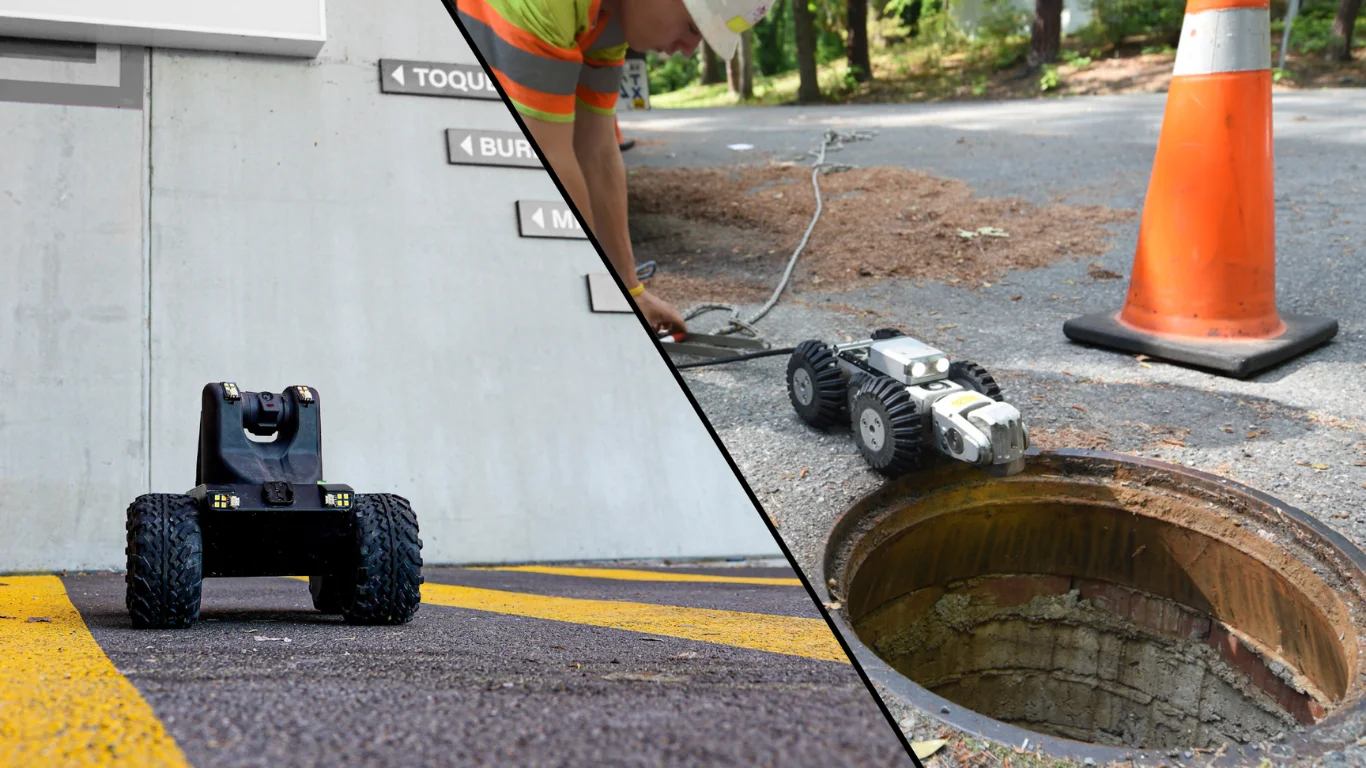
In the world of network inspection (sewerage, industrial pipes, technical conduits), the wired ITV trolley has long been the tool of choice. However, a growing number of operators are turning to a more modern and flexible alternative: the Roview2. This inspection robot developed by Multinnov , is reinventing television diagnostics, offering mobility, safety, and performance where traditional trolleys show their limitations. But why this shift? This article reviews the technical, economic, and operational reasons behind this transition.
The limitations of the traditional ITV cart
ITV (television inspection) cameras remain widely used, particularly for large-diameter pipes. They are reliable, simple, and well known to professionals. However, several limitations remain:
Cable dependency
The ITV trolley requires a cable (video/power) that limits the distance it can travel and makes it difficult to maneuver. When a network is convoluted, old, or in poor condition, the cable can become tangled or blocked. Multinnov emphasizes that the cable remains a logistical obstacle in complex environments.
Reduced mobility
Rolling carts are effective on linear networks, but struggle with obstacles, slopes, or vertical sections. Obstacles or uneven surfaces can block progress.
Operator safety
Some sections are flooded, very narrow, or poorly ventilated. Deploying a trolley in these areas may require large teams, safety measures, and heavy logistics.
Time and logistics costs
Deploying a trolley requires preparation (unrolling the cable, installation), and sometimes a suitable logistics vehicle—which increases costs and lengthens intervention times.
Range limitation
With a wired trolley, the effective range depends heavily on the length and quality of the cable. This restricts inspection to relatively short or easily accessible segments.
The advantages of the Roview2 alternative
Multinnov designed the Roview2 to overcome precisely these limitations and meet the needs of modern inspection:
- Wireless – freedom of movement: The Roview2 operates using secure radio transmission, without cables. This eliminates cable length constraints and the risk of snagging.
- Motorized 4K camera and powerful lighting: It features an ultra-high-definition (4K) camera mounted on a rotating turret (360° horizontal, 180° vertical), ensuring complete visual coverage. In addition, its powerful LEDs (up to 12,000 lumens) ensure optimal visibility, even in dirty, dark, or clogged pipes.
- Battery life and range: According to Multinnov, the Roview2 offers up to 2 hours of battery life when on the move. It can also cover significant distances: Multinnov claims a range of over 500 m, and the range extender option allows this distance to be exceeded under certain conditions.
- Buoyancy and robustness: One of the major advantages of the Roview2 is its ability to operate in flooded environments: thanks to blades on its wheels, it floats and can navigate, eliminating the need to drain a pipe for inspection. Its watertight hull and robust design increase its durability and reliability in harsh conditions.
- Stability and safety: The robot can remain stable at angles of up to 45°, and triggers an alert if it tips over at 30°, ensuring safe operation in sloping or uneven pipes.
- Telemetry and documentation: It measures data such as distance traveled via encoded wheels and includes tools for recording defects in accordance with standard NF EN 13508-2, ensuring that its ITV reports comply with professional standards. It combines photos, videos (1080p playback), and telemetry logs to produce detailed diagnostics.
- Simplified maintenance and transport: Weighing only ~4 kg, the Roview2 can be easily transported by a single operator. Its cable-free operation reduces logistics and maintenance costs associated with damaged cables.
Why operators are reevaluating their equipment choices
Given these advantages, many professionals are reevaluating their choices:
- Reduced operating costs: Fewer personnel, less logistical equipment, fewer machine stoppages or downtime, and faster inspections: the Roview2 can reduce costs in the long term.
- Time savings: Deployment is faster, inspection is smoother, and video feedback is immediate—accelerating decision-making and corrective action planning.
- Enhanced safety: By limiting operator exposure, the robot reduces risks associated with confined spaces, stagnant water, or hazardous conditions.
- Enhanced inspection quality: 4K images + telemetry + navigability in complex areas provide more accurate and actionable diagnostics.
- Technological flexibility: Thanks to its accessories (range extender, blades, batteries), the Roview2 can be adapted to a wide variety of missions, making it a versatile investment.
Multinnov, for its part, promotes this solution as a complement or even an alternative to ITV carts: in areas where carts cannot go, the Roview2 provides a solution without compromise.
The wired ITV trolley remains a reliable tool for inspections in easily accessible pipes. However, faced with increasingly complex networks, logistical constraints, and safety requirements, many operators are turning to more modern solutions. The Roview2 from Multinnov, with its wireless mobility, buoyancy, 4K camera, and autonomy, is establishing itself as a powerful and strategic alternative.
By adopting Roview2, professionals can not only optimize their inspections, but also reduce risks, increase efficiency, and control costs. This reconfiguration of inspection methods marks a real turning point in the field of ITV—combining innovation, safety, and economy.