Sewer mains play a vital role in transporting wastewater and stormwater. Subject to constant stress, they can be affected by cracks, leaks, deposits, or structural deformations that may impair their function.
For network operators, the challenge is twofold: maintaining infrastructure performance while minimizing human risk and service interruptions. It is in this context that the newvisual inspection solutions developed by Multinnov offer a concrete solution. Thanks to indoor drone and inspection robot technologies, it is now possible to explore complex structures more quickly, safely, and accurately.
The Challenges of Inspecting Sewer Mains
Inspecting underground networks is an essential step in managing sewer infrastructure. Local governments and operators must be able to quickly identify defects that could lead to malfunctions or significant repair costs.
However, manifolds have several limitations:
- difficult or limited access;
- a humid and sometimes corrosive environment;
- potential presence of hazardous gases;
- poor visibility;
- dimensions vary depending on the structure.
Traditionally,CCTV (closed-circuit television) inspections rely on the use of specialized equipment inserted into the networks or on manual inspections when the dimensions of the structures permit. These operations often require significant logistical resources and involve strict safety procedures.
In large, accessible collection systems or complex structures, working in confined spaces poses a major challenge. Reducing operator exposure while improving the quality of diagnostics has now become a priority for the entire industry.
The use of drones to inspect underground utility networks
Advances in technology now allow us to approach the inspection of collectors from a new perspective. At Multinnov, we develop solutions tailored to hard-to-reach environments to improve data collection while minimizing risks to personnel.
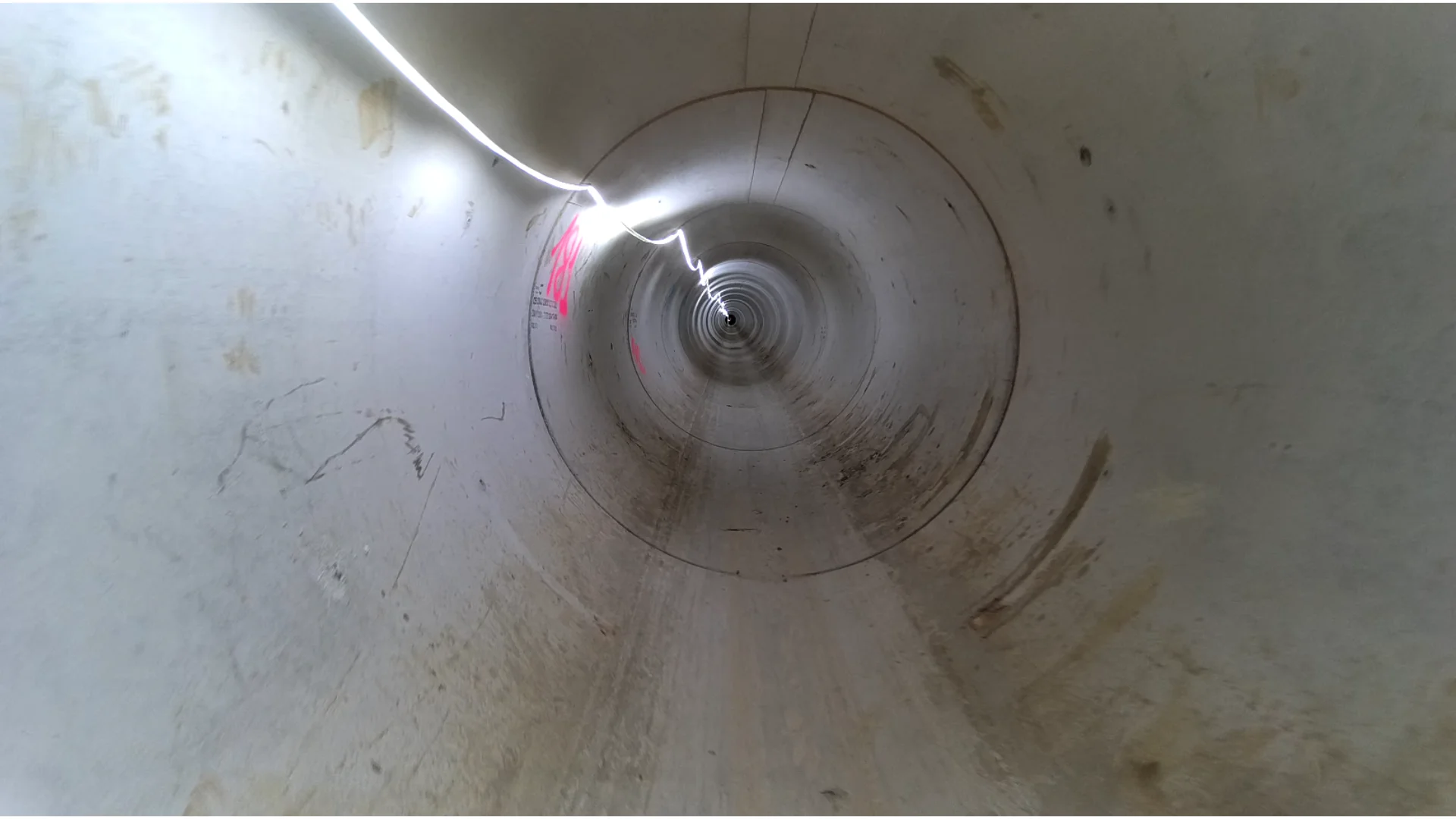
The Stereo3 is part of thisinnovation initiative. Designed to operate in confined spaces, this indoor drone enables rapid visual inspections within underground structures, utility tunnels, or large collection systems.
Thanks to its aerial mobility, it can access areas where traditional methods sometimes reach their limits. Its use allows for the collection of detailed images via its inspection camera, thereby facilitating the identification of various defects:
- cracks;
- leaks;
- corrosion;
- large deposits;
- obstructions;
- localized subsidence.
A drone inspection mission typically involves several steps:
Preparing for the procedure
Before any operation begins, a network analysis is conducted to identify available access points, traffic constraints, and any environmental risks.
Steering in the manifold
The drone is then deployed from a secure access point. Remote control allows for the exploration of different sections of the network without directly exposing crews to the harsh conditions of the environment.
Data collection
The recorded images and videos provide a reliable basis for accurately assessing the condition of the infrastructure.
Analysis of anomalies
The data collected is then used to identify defects and prioritize maintenance or rehabilitation work.
In some cases, the drone can be supplemented with ground-based solutions such as our Roview3, an inspection robot specifically designed for exploring pipes and hard-to-reach structures. This complementary approach allows us to tailor the inspection method to the network’s configuration and the objectives of the operation.
The benefits and prospects of this technology
The use of drones and inspection robots is gradually transforming maintenance practices for sewer systems.
The first benefit relates to safety. By limiting human intervention in confined spaces, operators significantly reduce their teams’ exposure to risks associated with gases, falls, or harsh environments.
Operationalefficiency is also a major advantage. Inspections can be conducted more quickly, with simplified preparation and reduced deployment of field resources.
This approach also helps improve operational efficiency. Early detection of anomalies allows for intervention before more significant damage occurs, which is often more costly to repair.
Operators also benefit from:
- improved traceability of inspections;
- comprehensive visual documentation;
- optimized work scheduling;
- more preventive than corrective maintenance;
- a better understanding of the actual condition of the heritage.
As infrastructure ages and regulatory requirements become stricter, robotic inspection technologies are expected to play an increasingly important role in the management of urban networks.
Forindustry and public sector stakeholders, these tools now represent much more than just a technical advancement: they contribute to smarter, safer, and more sustainable management of underground infrastructure.
Inspecting sewer collectors is a strategic priority for ensuring the performance and longevity of sewer systems. Thanks to advances in robotics and indoor drones, it is now possible to obtain accurate assessments while minimizing the risks associated with working in confined spaces.
At Multinnov, we develop solutions such as the Stereo3 and Roview3 to support operators in their visual inspection operations. This combination of innovation, safety, and efficiency improves infrastructure maintenance while optimizing costs and the quality of interventions.