In the maritime sector, inspection operations play a key role in ship safety, regulatory compliance, and operating cost control. However, inspections carried out in confined spaces such as bilges, tanks, or engine rooms are among the most complex to perform. Access constraints, human risks, and prolonged vessel downtime are all challenges for shipowners and operators.
The emergence of indoor drones dedicated to visual inspection is now opening up new possibilities for optimizing these operations. Drawing on proven technologies, Multinnov is integrating these solutions to transform naval inspections for the long term.
The limitations of traditional inspection methods in the naval environment
Historically, ship inspections have required significant human and logistical resources. Access to confined spaces often requires scaffolding, aerial work platforms, and even extensive preparatory work. In addition, there are strict safety procedures: forced ventilation, equipment lockout, wearing of specific protective equipment, and the presence of monitoring teams.
These methods have several major limitations. First, the human risks remain high. Confined spaces expose operators to potentially hazardous atmospheres, falls, or significant physical strain. Second, vessel downtime is often significant. Each inspection involves a partial or total interruption of operations, with a direct impact on profitability.
Finally, the quality of the data collected depends heavily on access and visibility conditions. Some areas remain difficult to observe, which can limit the accuracy of the diagnosis or require costly additional inspections.
Against a backdrop of increased economic and regulatory pressure, these limitations are prompting maritime stakeholders to rethink their inspection practices.
The contribution of indoor drones to optimizing ship inspections
Indoor inspection drones have been specifically designed to operate in confined, dark, and complex environments without the use of GPS. Their use in the naval environment provides a lever for optimization on several levels.
Firstly, they significantly reduce response times. A drone can be deployed quickly, without any complicated setup, and can access areas that were previously difficult and time-consuming to reach in just a few minutes. This speed directly translates into a reduction in vessel downtime.
In terms of safety, the impact is just as significant. By replacing human intervention in high-risk areas, drones greatly reduce operator exposure. Inspections can be carried out remotely from a secure location while maintaining a high level of accuracy. This approach is fully in line with occupational risk prevention measures.
Indoor drones also significantly improve the quality of the data collected. Equipped with high-resolution inspection cameras and advanced stabilization systems, they provide images and videos that can be used for analysis, traceability, and monitoring over time. This data can be integrated into maintenance, ITV, or regulatory compliance processes.
Finally, optimization translates into an overall reduction in operating costs. Fewer staff required, fewer logistical resources, less downtime: the economic equation becomes more favorable, without compromising on diagnostic reliability.
Why choose Multinnov drones for naval inspections?
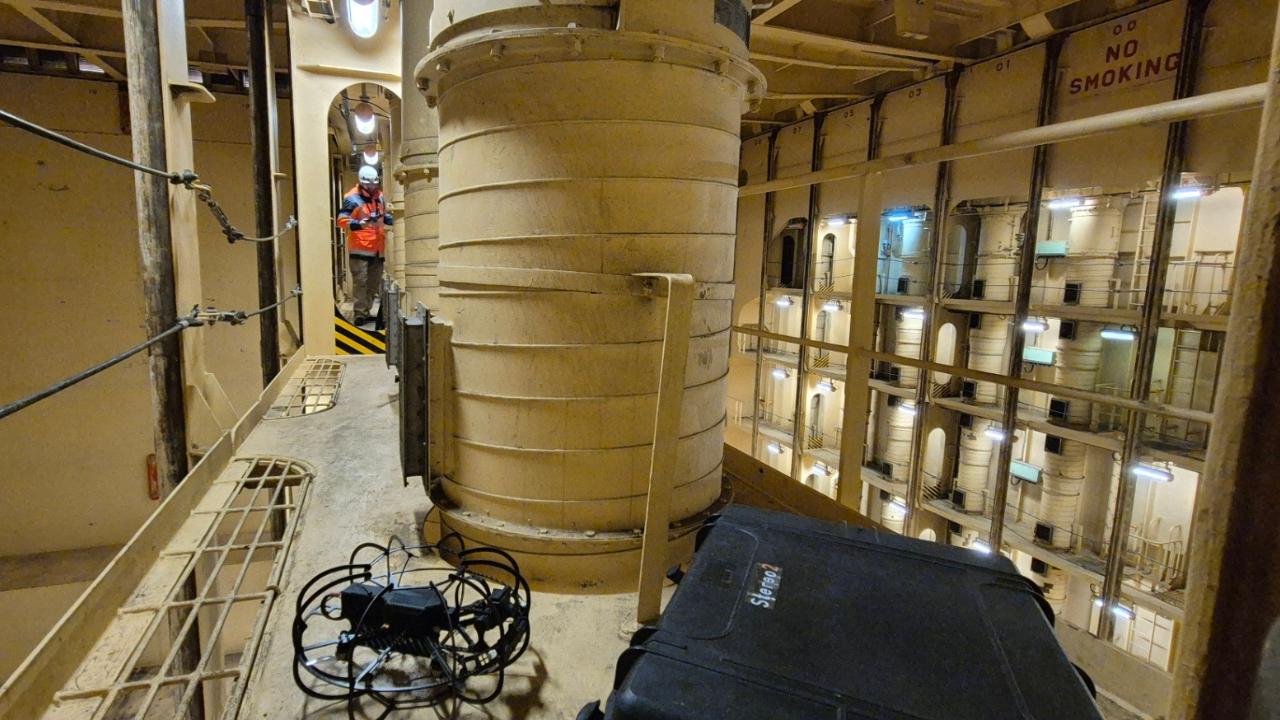
In this context, the solutions developed by Multinnov precisely meet the requirements of the maritime environment. Indoor drones such as the Stereo2 and Roview3 were designed to operate in complex industrial environments characterized by confined spaces, obstacles, and variable visibility conditions.
The Stereo2 stands out for its precise and stable navigation capabilities, even in confined spaces. Its robust design and onboard sensors enable reliable visual inspections in crawl spaces or technical compartments. The Roview3, meanwhile, is particularly suited to inspections of vertical structures and complex volumes, offering excellent visibility of walls and equipment.
Beyond the equipment, Multinnov's approach Multinnov approach is based on the complete integration of technology into inspection processes. The data collected is structured, analyzed, and presented in a way that is useful to operators, facilitating decision-making and maintenance planning. This control of the entire chain, from field intervention to analysis, is a key performance factor.
Inspecting ships in confined spaces is a major challenge for the maritime sector, both in terms of safety and economic performance. Indoor inspection drones now offer a concrete solution to the limitations of traditional methods, combining speed, safety, and data quality.
By relying on proven technological solutions such as Stereo2 and Roview3, Multinnov supports maritime professionals in optimizing their inspections, while ensuring that these operations are sustainable, efficient, and compliant with current industry requirements.