
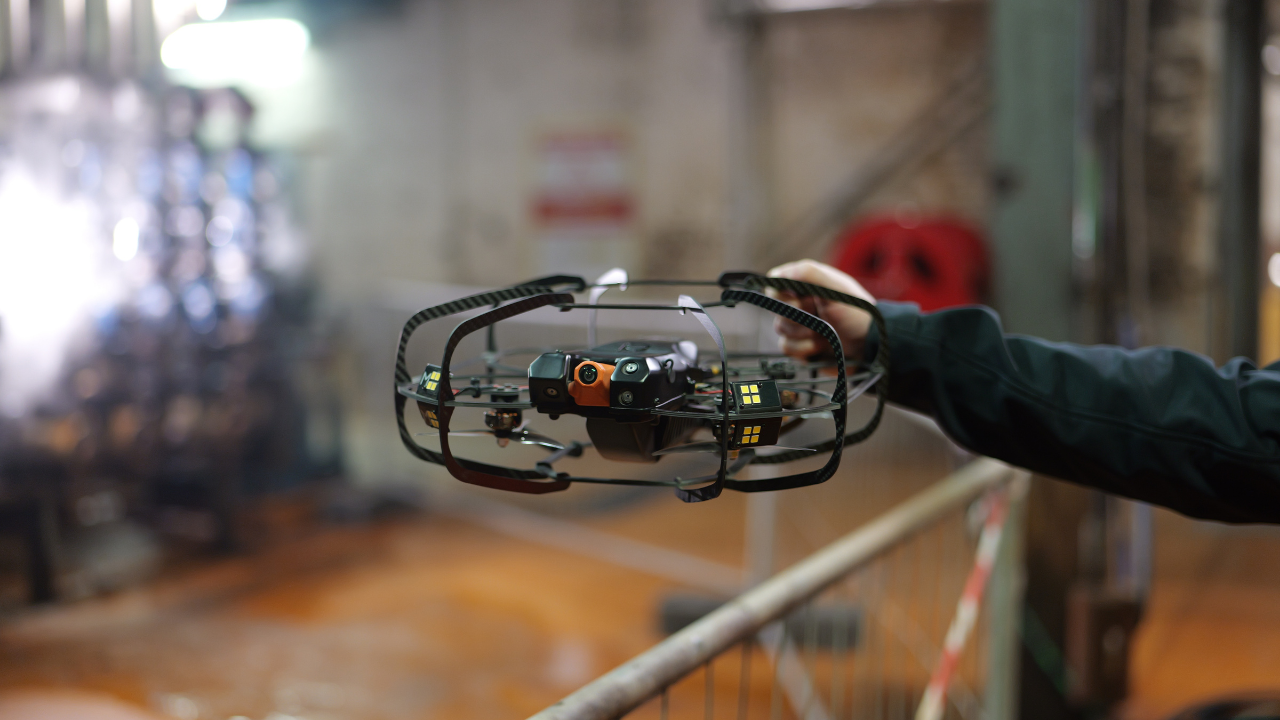
In the field ofindustrial inspection, drones have become indispensable tools. Their ability to access hard-to-reach or even dangerous areas makes them invaluable assets for operations in confined spaces.
But one question comes up often: how can a drone fly stably indoors, where GPS is completely unavailable?
In fact, unlike outdoor drones, which rely on satellites for positioning, indoor drones must operate in a closed, complex environment that sometimes lacks obvious visual landmarks.
The answer lies in advanced technology: stereoscopic vision. This technology is used in particular in solutions developed by companies such as Multinnov, it allows the drone to “see” its surroundings in three dimensions and pinpoint its location without GPS.
The Challenges of Indoor Flight Without GPS
Flying a drone outdoors is relatively easy these days thanks to geolocation systems. Indoors, however, the situation is completely different.
An environment without satellite signals
GPS does not work inside buildings or in enclosed industrial structures. This means that the drone cannot:
- know one's exact location
- automatically stabilize its flight
- maintain a precise course
Without an alternative solution, the drone would become unstable and difficult to fly.
Complex and constrained environments
Industrial environments, particularly in the nuclear sector, present additional challenges:
- tight spaces
- multiple obstacles
- lack of natural light
- smooth surfaces (concrete, metal)
These conditions make navigation even more difficult.
A major security issue
In these situations, even the slightest mistake can lead to:
- a collision
- a loss of control
- property damage
To ensure reliable visual inspection, the drone must therefore be able to stabilize itself in real time without relying on an external system.
The principle of stereoscopic vision
To address these challenges, indoor drones rely on technology inspired by… human vision.
See in 3D with two cameras
Stereoscopic vision relies on the use of two inspection cameras placed side by side. Each camera captures a slightly different image of the scene.
The principle is simple:
- Each image represents a different angle
- the system compares these two images
- he calculates the depth and distances
That’s exactly what our brain does with our two eyes.
A 3D reconstruction of the environment
Based on this analysis, the drone is capable of:
- create a 3D map of one's surroundings
- identify the obstacles
- measure distances accurately
This three-dimensional perception is essential for navigating complex spaces.
Technology at the heart of innovation
In theindustrial sector, this approach represents a major breakthrough. It enables a simple drone to be transformed into a fully-fledged inspection robot capable of analyzing its environment in real time.
When combined with other sensors (inertial, optical), it forms the basis of modern navigation systems used in indoor drones.
Stabilization and navigation using 3D perception
Stereoscopic vision isn't just for "seeing"; above all, it allows the drone to navigate and stabilize itself.
Estimate your location in real time
By continuously analyzing the images it captures, the drone can:
- watch one's own movements
- detect changes in position
- adjust its course instantly
This process, known as visual odometry, replaces GPS indoors.
Maintain stable flight
Using this information, the drone is capable of:
- to remain stationary in the air (hovering)
- automatically avoid obstacles
- follow a precise path
Even in complex environments, it maintains excellent stability.
Tangible benefits for inspections
This autonomous navigation capability directly improves inspection performance:
- increased safety: reduced risk of collisions
- efficiency: faster response times
- data quality: stable and usable images
In demanding sectors such as the nuclear industry, these advantages are crucial.
Cost-effective optimization
By reducing errors, response times, and the need for complex logistics, this technology also helps improve operational efficiency.
This allows companies to:
- keep costs down
- improve productivity
- optimize maintenance
Flying indoors without GPS poses a real technological challenge. However, thanks to innovations such as stereoscopic vision, drones are now capable of navigating with precision and stability even in the most complex environments.
By combining 3D perception, real-time analysis, and advanced technology, these systems transform drones into powerful and reliablevisual inspection tools.
For companies such as Multinnov, these solutions pave the way for a new generation of operations in confined spaces, where safety,efficiency, and data quality become the norm.
As these technologies continue to evolve, indoor drones are emerging as an indispensable pillar of industrialinnovation, capable of addressing the most demanding challenges while pushing the boundaries of technical exploration.