
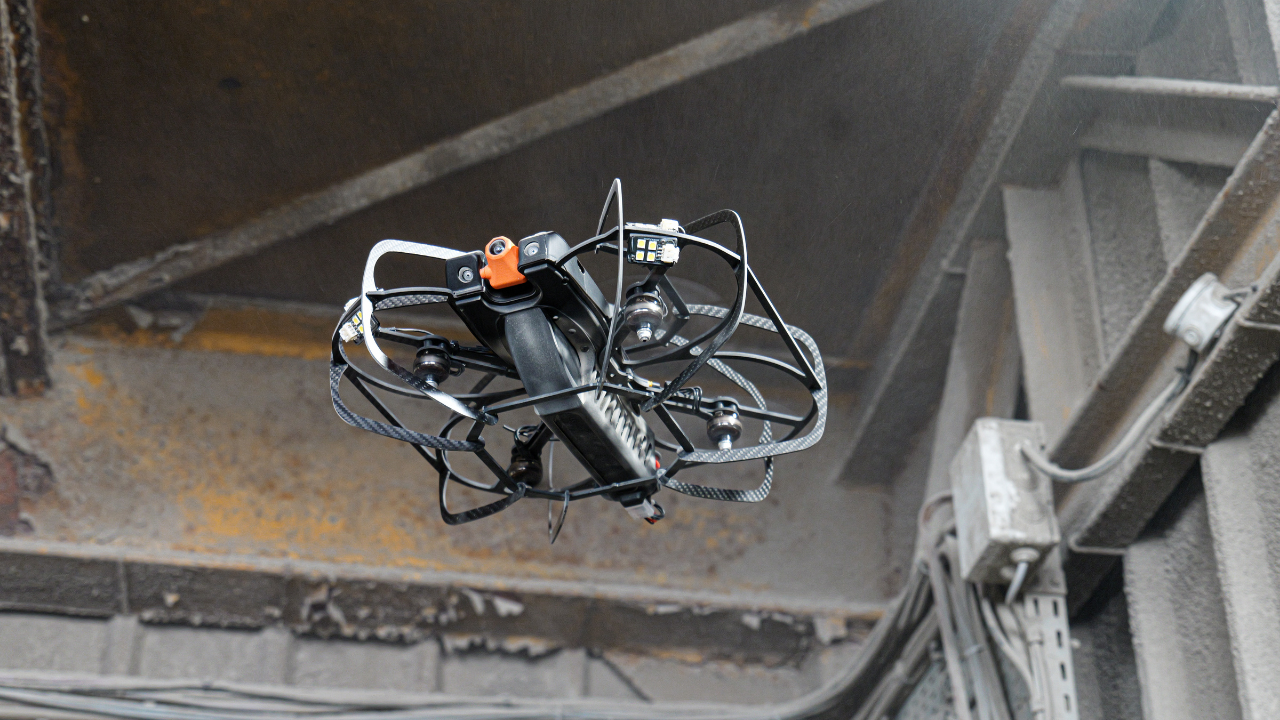
In the face of these challenges, traditional methods are reaching their limits. It is in this context that indoor drones are gradually emerging as an indispensable solution.
Developed in particular by Multinnov, these technologies modernize visual inspection in industrial settings by combining innovation, safety, and operational performance.
The Challenges of Inspections in Confined Spaces
Confined spaces alone account for a large portion of the challenges associated with industrial inspections.
High-risk environments
Operators working in these areas are exposed to several hazards:
- Toxic atmospheres or lack of oxygen
- Risk of falling or collapse
- Tight spaces or hard-to-reach areas
- Low visibility conditions
These constraints make certain inspections complex, if not dangerous. In many cases, they require heavy equipment such as scaffolding, aerial work platforms, or the assistance of rope access technicians.
Time-consuming and costly operations
Traditional inspections often involve:
- Significant preparation time
- Partial or complete shutdown of facilities
- Mobilization of qualified personnel
The result: high costs and limited productivity.
A growing need for precision
In an increasingly demanding industrial environment, inspections must provide reliable and actionable data.
Identifying a crack, corrosion, or structural deformation today requires:
- High image quality
- The ability to analyze quickly
- Traceability of observations
However, these requirements are difficult to meet using traditional methods.
Drones as an innovative solution
Indoor drones are specifically designed to address these challenges. Engineered to operate without GPS in enclosed spaces, they represent a true technological breakthrough.
Unmatched accessibility
Indoor drones can access areas where humans cannot go:
- Tanks
- Ducts
- Industrial chimneys
- High-rise structures
This makes it possible to quickly inspect complex areas without deploying heavy infrastructure.
Advanced onboard technologies
To operate indoors, these drones rely on several technologies:
- High-definition cameras
- Distance sensors (LiDAR, ultrasonic)
- GPS-free stabilization systems
- Built-in lighting for dark areas
This combination enables precise navigation and real-time data collection, even in challenging environments.
Real-time visual inspection
Thanks to the instant transmission of images:
- Operators can analyze structures in real time
- Anomalies are detected immediately
- Decisions can be made immediately
This capability is fundamentally transforming the way industrial inspections are conducted.
Benefits for safety and maintenance
The integration of indoor drones into inspection processes offers tangible benefits at every level.
Enhanced safety
That is one of the major benefits.
Drones make it possible to eliminate or significantly reduce human exposure to hazardous areas. Operators remain at a distance while retaining full control over the inspection.
This approach helps reduce accidents and improve working conditions, a key priority in modern industry.
Significant time savings
Drones make it possible to inspect a facility in a fraction of the time required using traditional methods.
- Rapid deployment
- Inspection without erecting scaffolding
- Immediate access to critical areas
Some inspections can now be completed in just a few hours, compared to several days in the past.
Cost reduction
By eliminating the need for heavy logistical resources, drones can significantly reduce costs:
- Fewer workers mobilized
- Less equipment required
- Fewer production stoppages
According to some analyses, drone inspections can result in significant cost savings compared to traditional methods.
Data accuracy and quality
Indoor drones provide high-quality inspections thanks to:
- High-resolution images
- Multiple perspectives
- A tendency to focus on flaws
They enable rapid detection of:
- Corrosion
- Cracks
- Deformations
- Obstructions
This data can then be used to improve maintenance and predict failures.
Toward Smarter Maintenance
Beyond mere monitoring, drones are part of a predictive maintenance strategy.
The data collected makes it possible to:
- To track changes in structures over time
- To plan ahead for interventions
- To optimize the management of industrial assets
Inspection thus becomes a valuable decision-making tool.
Indoor drones are redefining the standards of industrial inspection. In the face of the challenges posed by confined spaces, they offer a practical solution that combines safety, efficiency, and precision.
By enabling access to complex areas without putting operators at risk, while collecting reliable real-time data, these technologies are emerging as a key driver of performance.
With its innovative solutions, Multinnov is fully committed to this transformation. Visual inspection is becoming smarter, faster, and better integrated with today’s industrial challenges.
Adopting indoor drones is no longer just about modernizing your control systems. It involves a fundamental rethink of how to operate, secure, and maintain