
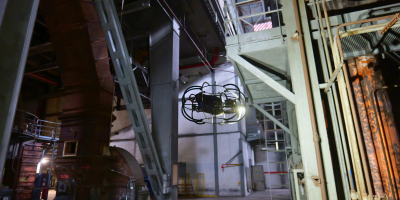
In many industrial sectors, inspecting enclosed, confined, or hard-to-reach spaces poses a major technical and human challenge. Silos, tanks, technical galleries, structures, industrial facilities, and dilapidated buildings often require lengthy, costly, and potentially dangerous interventions for operators. Faced with these constraints, indoor drones are emerging as a strategic innovation. Developed to operate without GPS in complex environments, these platforms, such as Multinnov'sStereo2, are profoundly transforming visual inspection and technical diagnostic practices.
What is an indoor drone and how does it work?
An indoor drone is a drone specifically designed to fly inside enclosed structures, where conventional drones reach their limits. Unlike outdoor models, it does not use GPS signals for positioning. It relies on advanced onboard technologies such as stereoscopic vision, inertial sensors, stabilization systems, and sometimes real-time 3D mapping.
The Stereo2, developed by Multinnov, perfectly illustrates this approach. It is equipped with high-resolution cameras that enable accurate visual inspection, even in low-light environments. Its navigation system is based on continuous analysis of the environment, allowing it to move steadily in narrow or complex spaces.
Safety is at the heart of the design of these drones. Peripheral protections, often in the form of a cage or absorbent structure, allow them to fly in close proximity to walls without risk of damage to the device or the infrastructure being inspected. This feature is essential for working in confined spaces where there is limited room for maneuver.
Thanks to real-time video transmission, the operator retains complete control over the inspection while remaining at a distance from hazardous areas.
Areas of use for indoor drones
Indoor drones have numerous applications across a wide range of professional sectors.
Industry and maintenance
In industry, indoor drones are used to inspect silos, tanks, boilers, industrial chimneys, and production facilities. They can detect cracks, deposits, corrosion, and structural defects without requiring prolonged shutdowns of the facilities.
Building and infrastructure
In buildings, these drones facilitate the inspection of roof structures, vaults, ceilings, stairwells, and damaged structures. They are particularly useful during pre-construction or post-disaster assessments, when human access is limited or dangerous.
Confined spaces and ITV
As part ofvisual inspections and ITVs, indoor drones effectively complement ground-based inspection robots. They make it possible to explore aerial spaces that are inaccessible to traditional cameras, while ensuring that detailed images are collected.
Sensitive sites and risk areas
Environments presenting chemical, thermal, or structural risks also benefit from this technology. The drone thus becomes a valuable prevention tool, limiting human exposure while ensuring the quality of the diagnosis.
The advantages and prospects of indoor drones
The adoption of indoor drones brings tangible benefits at every stage of the inspection process.
Enhanced safety
By replacing human intervention in hazardous areas, drones significantly reduce the risk of accidents. Operators remain at a distance, in a secure environment, while maintaining a complete view of the area being inspected.
Time savings and operational efficiency
An indoor drone inspection is generally much faster than a traditional inspection requiring scaffolding, aerial work platforms, or rope access. Images are captured in a matter of minutes and can be used immediately.
Data accuracy and quality
High-definition onboard cameras provide detailed images that can be used for detailed analysis. This improves the reliability of diagnostics and facilitates technical decision-making.
Cost reduction
Less labor required, fewer heavy-duty resources, fewer interruptions to operations: using an indoor drone can generate significant savings on inspection and maintenance operations.
Future prospects
In the future, the integration of artificial intelligence, 3D modeling, and automated image analysis will further enhance the potential of these solutions. Indoor drones will become a central link in predictive maintenance and infrastructure management strategies.
Indoor drones are now an essential tool for exploring inaccessible areas. Thanks to innovative solutions such as Multinnov'sStereo2, professionals have access to reliable, secure, and high-performance technology for inspecting complex environments without compromising the safety of their teams.
By combining high-precision visual inspection, operational efficiency, and reduced human risk, indoor drones are redefining the standards for inspection in confined spaces. For industry, construction, and maintenance, this is no longer a marginal option, but rather a strategic lever for optimizing diagnostics, controlling costs, and sustainably improving the safety of operations.