
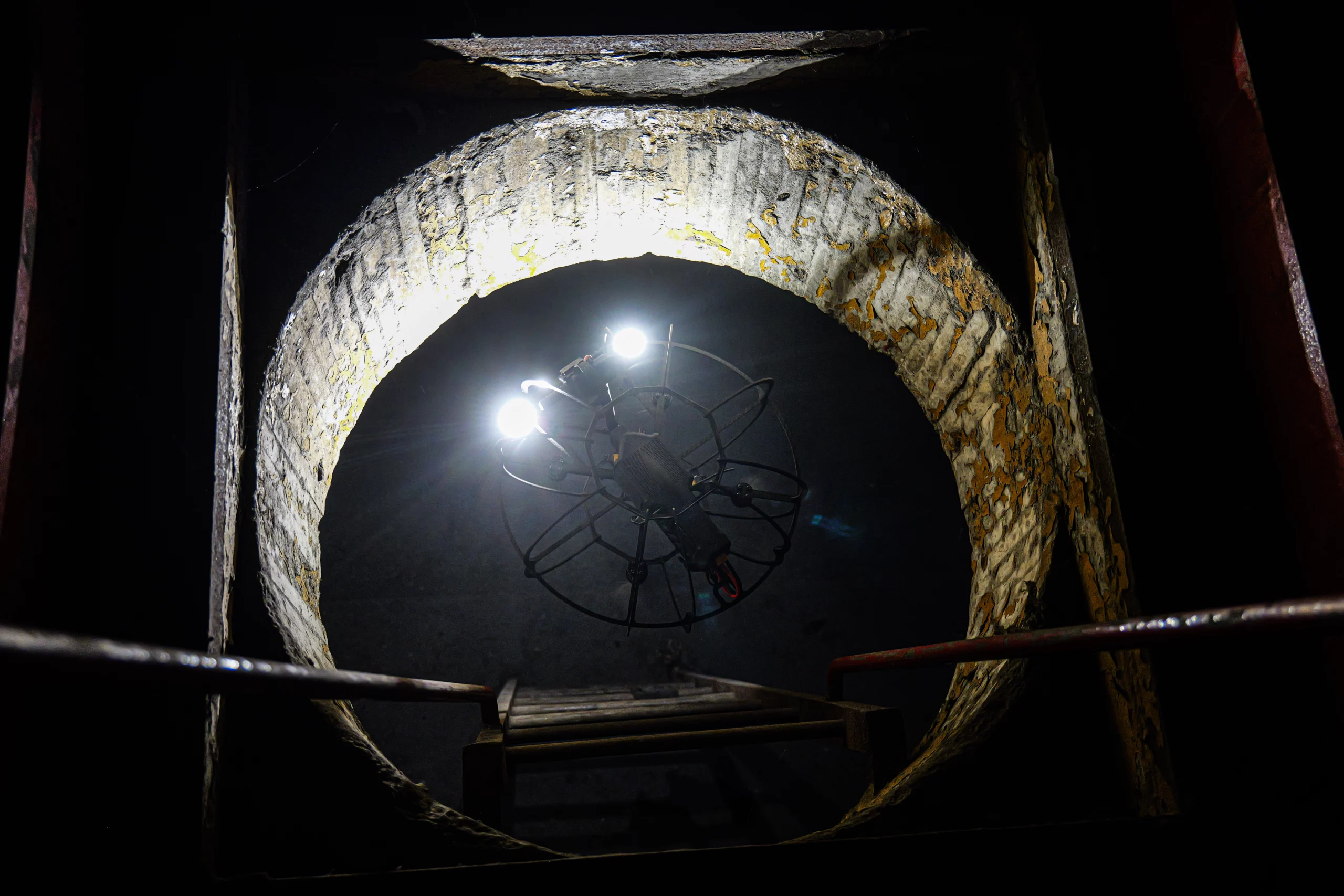
In modern industry, many sites have what are known as confined spaces: tanks, silos, reservoirs, tunnels, technical ducts, sewage or drainage pipes. These spaces are often difficult to access, dark and sometimes dangerous, and require a high level of safety for human intervention. Faced with these constraints, the use of specialized drones is an innovative and strategic response. Thanks to them,safe exploration becomes possible: access to inaccessible areas, precise visual inspection, collection of exploitable data - all while reducing risks for operators.
In this article, we first look at the challenges of exploration in confined environments, then outline how drones provide cutting-edge solutions, and finally present concrete applications and best practices for maximizing their effectiveness.
The challenges of exploration in confined environments
Confined environments present several major challenges for exploration and inspection:
Restricted access: Physical access may be limited or impossible. Passages may be narrow, winding, sloping, partially submerged or under pressure. This complicates the movement of a technician or the use of conventional equipment such as ITV carts.
Hostile conditions: hazardous atmospheres such as toxic or explosive gases, lack of oxygen, humidity, mud, corrosion and total darkness can sometimes be found. These factors complicate the human mission and increase safety-related costs.
Reduced mobility and visibility: In the absence of natural light, traditional inspections require powerful lighting or heavy equipment. In addition, visibility is often very poor, reducing the quality of the data collected.
High costs and response times: Organizing a mission in a confined environment requires strict safety protocols, permits, clean-up, logistical arrangements, and often production stoppages. Time and cost increase.
These constraints are prompting industrial managers to look for safer, faster and more economical methods of carrying out visual inspections in these areas.
Using drones for safe exploration
Drones designed for confined environments offer a powerful alternative to traditional methods. Several technological innovations make these devices particularly suitable:
Technology for GPS-free environments: As Flyability explains, indoor drones are able to operate in GPS-free environments, using proximity, visual, inertial and even LiDAR sensors to navigate and avoid obstacles.
Robustness and built-in safety: These drones are often fitted with protective cages or reinforced structures to resist collisions. This makes them ideal for use in narrow, congested or low-visibility areas.
High-precision visual inspection: 4K cameras, powerful LED lighting and real-time transmissions produce usable images for inspection and maintenance. One article states that the use of drones in confined environments can reduce costs by up to 90% compared with traditional methods.
Access to hazardous areas without direct human intervention: The biggest advantage of indoor drones is safety: operators stay out of the danger zone. Inspections take place faster, more frequently, and with fewer constraints.
In this context, solutions such as Stereo2 or Roview2 from Multinnov are professional tools for confined spaces, thanks to their design, maneuverability and lighting and imaging capabilities.
Applications and best practices
Concrete applications
- Tank and vat inspection: UAVs can penetrate vertical or circular spaces to check walls, welds, corrosion or deposits without complete emptying.
- Sewer networks and pipes: Access to narrow or winding pipes, to identify roots, cracks, blockages or infiltrations.
- Tunnels, galleries and technical shafts: rapid inspection with no disruption to service and minimal disruption to business.
- Industrial sites and silos: frequent inspection of internal components, detection of visual anomalies, verification of technical installations inside confined spaces.
Best practices
- Site survey and preparation: understanding access, layout, lighting, signal and atmosphere constraints.
- Aircraft calibration and test: check sensors, lighting, transmission, flight stability.
- Slow, methodical progress: use appropriate speeds, capture multiple images (profile, dive, close-up) for complete documentation.
- Data processing: restitution of high-definition images/videos, anomaly reports, 3D modeling if possible.
- Safety and maintenance: check device condition, clean lenses, test lighting, replace abraded parts.
By adopting these methods, professionals maximize the safety, reliability and cost-effectiveness of work in confined spaces.
The evolution of indoor drone technologies is opening up a new chapter in confined space inspection: safer, faster and better documented interventions. The use of equipment such as Multinnov's Stereo2 or Roview2 symbolizes this transition towards innovative visual inspection, where the operator remains out of harm's way, data is accurate, and costs are kept under control.
For maintenance managers, infrastructure engineers or facility managers, adopting these solutions represents a major step forward: minimizing human risks, maximizing efficiency and anticipating anomalies before they compromise production or safety. Safe exploration by drone in confined environments is now a strategic asset in the industry.