
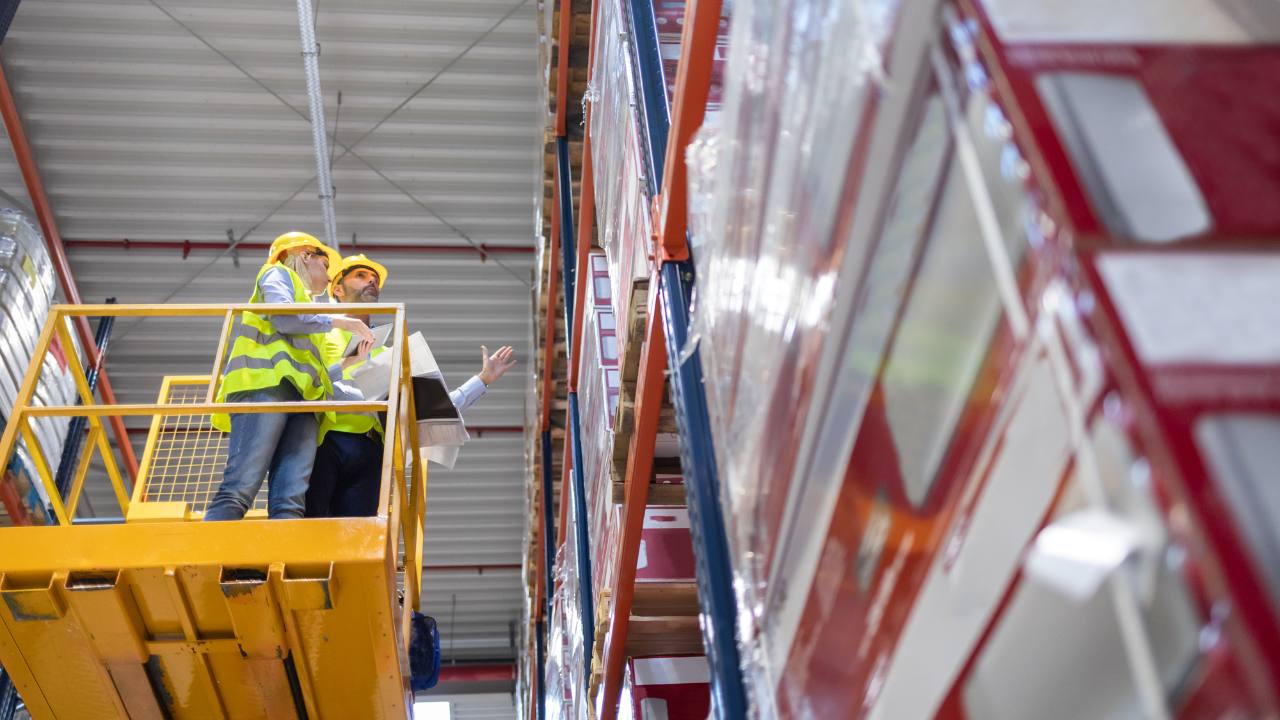
In industrial and logistics environments, working at height is part of everyday life. Inspection of structures, equipment checks, preventive or corrective maintenance: these operations have long relied on proven solutions such as scaffolding and aerial work platforms. While these methods remain effective, they also present significant constraints in terms of safety, cost, and time.
Today, the rise of drones, inspection robots, and autonomous systems is revolutionizing these practices. By offering faster, safer alternatives that are better suited to complex environments, these machines are redefining how work at height is carried out in industry and logistics.
Scaffolding and aerial work platforms: traditional solutions under pressure
For decades, scaffolding and aerial work platforms have been the standard solution for accessing heights. Their main advantage lies in their versatility and their ability to allow direct human intervention. However, these solutions come with structural constraints that are becoming increasingly difficult to ignore.
In terms of safety, working at height remains one of the leading causes of serious accidents in industry. Despite protective equipment and strict procedures, operators remain highly exposed to the risks of falls, fatigue, and human error.
Added to this are significant logistical constraints: assembly and dismantling of structures, partial immobilization of facilities, coordination of several trades. These steps lengthen intervention times and generate significant costs.
Finally, in certain environments—confined spaces, areas that are difficult to access, complex or sensitive infrastructure—installing scaffolding or using aerial work platforms becomes technically difficult, if not impossible. These limitations are driving manufacturers to seek more agile alternatives.
The emergence of autonomous machines: a new way of working at height
Faced with these challenges, automation and robotics provide concrete solutions. Drones, inspection robots, and autonomous systems now make it possible to carry out visual and technical inspections without directly exposing operators to risk.
Inspection drones, particularly those designed to operate in confined or industrial environments, can quickly access high or hard-to-reach areas. Equipped with high-resolution inspection cameras, they collect accurate data while drastically reducing intervention times.
Ground-based or aerial inspection robots complement this approach by providing increased stability and extended intervention capabilities in certain specific contexts. The benefits are numerous. In terms of safety, reducing human exposure is a major step forward. From an operational standpoint, autonomous machines increase efficiency through rapid deployment, repeatable inspections, and actionable data for ITV and maintenance.
Economically speaking, the reduction in heavy logistics resources and production stoppages translates into measurable savings, while improving the reliability of diagnostics.
Towards augmented industrial sites: integration, limitations, and prospects
The integration of autonomous machines into industrial environments is not simply a matter of replacing tools. It is part of a broader transformation towards augmented industrial sites, where data plays a central role. Inspections by drone or robot generate actionable information for monitoring facilities, anticipating failures, and optimizing maintenance cycles.
Multinnov is fully committed to this dynamic by developing technological solutions dedicated to visual inspection in complex environments. The indoor drones and inspection robots designed by the company meet industry requirements for robustness, precision, and safety, while integrating with existing processes.
However, this transition is not without its limitations. Regulatory constraints, particularly those related to the use of drones, still restrict certain deployments. Human factors also remain essential: automation does not eliminate the need for expertise, but shifts it toward analysis, data interpretation, and decision-making.
Finally, certain interventions still require direct human presence, particularly for repair or modification operations.
In industry and logistics, scaffolding and aerial work platforms will not disappear overnight. Nevertheless, the rise of autonomous machines, drones, and inspection robots marks a profound change in practices. By improving the safety, efficiency, and quality of inspections, these technologies offer a credible and complementary alternative to traditional methods.
By developing solutions tailored to complex industrial environments, Multinnov is contributing to this transformation towards safer, more efficient modes of intervention that are better aligned with the economic and human challenges of modern industrial sites.