Inspecting confined spaces remains one of the most challenging tasks in industry. Tanks, silos, utility tunnels, enclosed structures, and hard-to-reach areas often present complex working conditions: poor visibility, restricted access, obstacles, physical hazards, or uncertain atmospheric conditions.
At Multinnov, we have designed the Stereo3 to meet this specific need: to enable professionals to perform visual inspections in confined spaces without unnecessarily exposing their teams. The goal is simple: to make inspections safer, faster, and more actionable, while maintaining data quality that meets industrial standards.
The Stereo3 is an indoor drone designed to go where human access is difficult, costly, or risky. It allows users to document the condition of infrastructure, identify anomalies, and facilitate decision-making without having to routinely deploy heavy equipment such as scaffolding or aerial work platforms.
Introduction to the Stereo3 Drone
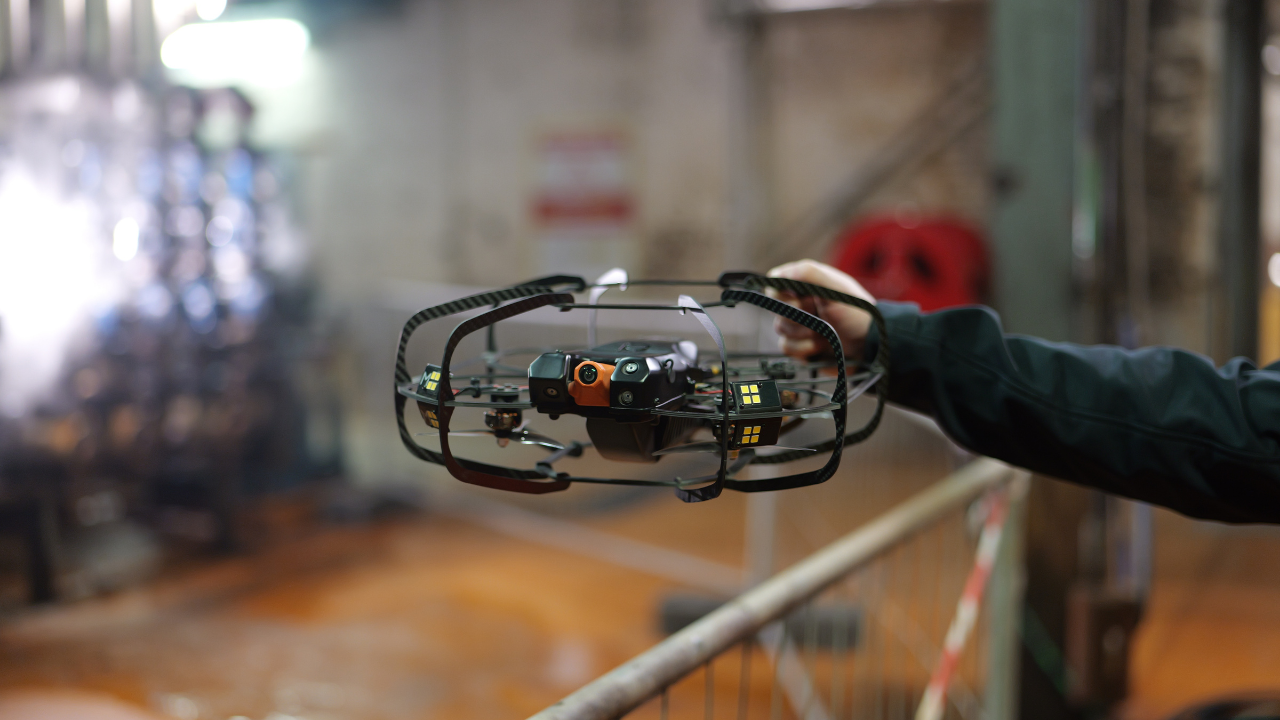
The Stereo3 is our indoor inspection drone designed for confined and complex environments. Unlike a conventional outdoor drone, it is designed to operate in enclosed spaces, often without GPS, where stability and flight control are critical.
Its role is to provide operators with a clear and detailed view of hard-to-reach areas. Thanks to its inspection camera and live video feed, the Stereo3 serves as a powerfulvisual inspection tool, capable of assisting teams with their inspection, diagnostic, and maintenance tasks.
We have incorporated several key features into the Stereo3 that are essential for industrial applications:
- optical stabilization suitable for flight without GPS;
- a camera capable of recording up to 4K;
- real-time video feedback;
- powerful lighting for dark environments;
- a carbon fiber roll cage;
- wireless control.
This design allows the drone to operate in confined spaces where visibility is limited and where contact with the surroundings can be difficult to avoid. The carbon fiber cage plays a key role here: it protects the drone during inspections and ensures safe movement near walls.
Stereo3 does not replace human expertise. It complements it. It gives teams quick visual access to areas that would otherwise require extensive preparation or direct intervention in confined spaces.
Performance and Applications in Confined Spaces
Confined spaces present very specific challenges. They are often dark, narrow, irregular, and sometimes difficult to ventilate or secure. For a conventional inspection, this typically involves time-consuming procedures and direct exposure for operators. With the Stereo3, our approach is to put technology on the front lines.
Stabilization designed for environments without GPS
The Stereo3 uses stereoscopic vision for optical stabilization. This technology helps the drone better perceive its surroundings, estimate distances, and maintain a more stable flight in enclosed spaces.
For the operator, this results in a smoother inspection process and more usable images. In an industrial setting, this stability is essential: a video that is too shaky or poorly lit can compromise the quality of the diagnosis.
A 4K camera for capturing fine details
Inspection relies primarily on image quality. The Stereo3 can be equipped with a 4K camera to capture details relevant to the analysis: cracks, corrosion, deformations, deposits, or surface defects.
These images can then be used to document an inspection report, compare the condition of a structure over time, or plan a targeted maintenance operation.
Lighting designed for dark areas
In tanks, tunnels, or enclosed spaces, natural light is generally absent. The Stereo3 features powerful lighting designed to improve visibility in these conditions.
This helps minimize shadows and provides a more reliable reading of the inspected surfaces.
There are many use cases:
- inspection of tanks and reservoirs;
- silo inspection;
- inspection of utility tunnels;
- inspection of enclosed industrial structures;
- visual inspection prior to maintenance;
- inspection of areas at height or that are difficult to access.
In these situations, indoor drones offer real operational flexibility. They allow for a quick initial assessment without immediately deploying heavy logistical resources.
Benefits for professionals
The main benefit of Stereo3 is that it makes inspections easier to organize, while improving safety and data quality.
Reduce operator exposure
Inspecting confined spaces always involves some risk. By using an indoor drone, teams can stay at a distance and observe the environment from a safe location.
This helps limit exposure to the following risks:
- in hard-to-reach areas;
- in tight spaces;
- the lack of visibility;
- in potentially hazardous atmospheres;
- work at heights.
This reduction in human exposure is one of the major benefits of roboticinnovation inindustry.
Save time on inspections
The Stereo3 helps reduce setup time. In many cases, it eliminates the need to immediately resort to scaffolding, aerial work platforms, or complex access systems.
Inspections can be initiated more quickly and with less logistical effort. This efficiency offers a tangible benefit to operators who need to regularly inspect their facilities.
Improve the documentation of diagnoses
The images and videos collected make it easier to track maintenance work. They enable the creation of clear visual reports, allow observations to be shared with technical teams, and help prioritize maintenance tasks.
This visual data serves as a decision-making tool. It helps target interventions, avoid unnecessary operations, and better track changes in infrastructure.
Reduce operating costs
Fewer complex access points, less downtime, and less human exposure: Stereo3 helps improve the overall cost-effectiveness of inspection operations.
It’s not just about saving time on a service call. It’s also about making inspections more frequent, simpler, and better integrated into preventive maintenance strategies.
With the Stereo3, we wanted to address a very specific challenge: enabling professionals to inspect confined spaces more safely, accurately, and easily.
This indoor drone combines optical stabilization, a 4K camera, powerful lighting, a carbon fiber frame, and wireless control to provide a solution tailored to complex industrial environments. It helps teams visually access hard-to-reach areas, collect reliable data, and make more informed maintenance decisions.
For Multinnov, the inspection of tomorrow must be safer, more agile, and smarter. The Stereo3 is fully aligned with this vision: putting technology at the service of operators, not to replace their expertise, but to give them better tools to work efficiently.