
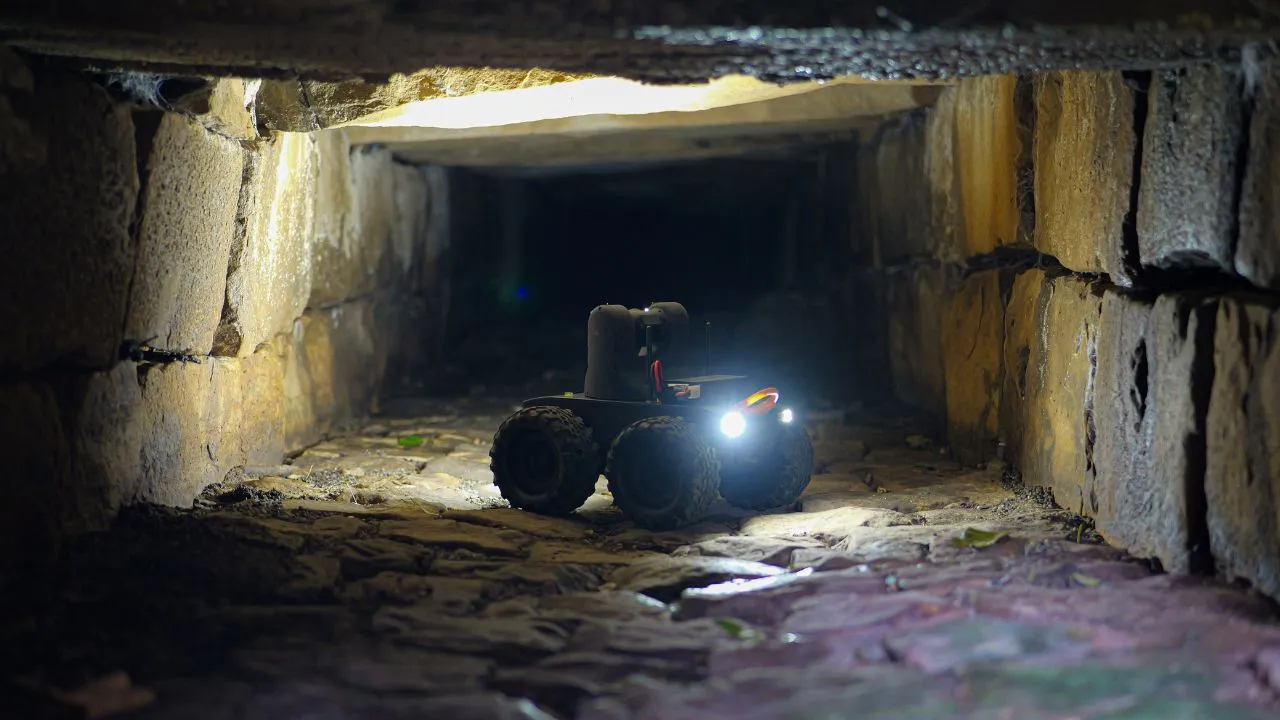
In the sanitation sector, sewer systems, pipes and collectors are subject to constant mechanical, chemical and biological stress. Cracks, obstructions or infiltrations can go undetected, leading to major breakdowns or environmental damage.Camera inspection, particularly via drones or robots adapted to confined environments, plays a decisive role in preventive maintenance. By enabling access to difficult or dangerous areas, this technology offers a safe and effective way of monitoring the condition of infrastructures, anticipating risks and planning interventions before incidents occur.
In this article, we first discuss the specific challenges of exploration in confined environments, and then look at how drones from Multinnov (Stereo2, Roview2) provide innovative solutions, before presenting some practical applications and best practices.
The challenges of exploration in confined environments
Hostile environmental conditions
Sewer networks are often dark, damp, partially flooded, and saturated with particles, sludge or noxious gases. These conditions prevent intervention by the naked eye, make lighting difficult, and interfere with standard optical sensors.
Restricted access
Trenches, manholes or buried sections may be too narrow or winding for a human operator to penetrate. Some sections are under hydraulic pressure, on slopes, or in unstable conditions - making access dangerous or impracticable.
Risks for operators
Sending operators into such environments is fraught with danger: lack of oxygen, toxic gases, slips, falls, contact with slag or waste. Even with protective equipment, active exposure to such environments remains a risky gamble.
Limits of conventional techniques
Traditional methods (manual inspection, wire camera, spot probing) often require shutdowns, mobilization of scaffolding, pre-cleaning, and sometimes provide limited coverage or blind spots.
These challenges call for the use of advanced visual inspection technologies, capable of operating in the most demanding conditions without compromising safety.
Using drones for safe exploration
Adapted indoor drones: the Stereo2
Multinnov offers its Stereo2 a drone designed to inspect confined spaces with precision. Among its remarkable features:
- 4K camera with fixed focus to avoid loss of sharpness due to dust or dirt.
- Powerful LED lighting system (10,000 lumens) divided into 4 panels to reveal surfaces even in low-light conditions.
- Stabilized flight in GPS-free environments, thanks to visual odometry and stereoscopic stabilization.
- Compact structure (diameter 39 cm), carbon protection cage, and flight time of around 12 minutes.
With Stereo2, you can enter tanks, vats, empty chambers or interior technical areas, filming in real time walls, welds or defects that would otherwise be invisible.
ITV robots and carts as a complement
For portions or pipes accessible from the ground, Roview2 is Multinnov's wireless TV inspection robot. It combines mobility, a rotating panoramic camera (360° horizontal, 180° vertical), multiple LED lighting, and the ability to cross obstacles in partially damp environments.
The mixed approach - drone in confined airspace + ITV robot on the ground - offers complete network coverage, without the need for direct human intervention.
Enhanced safety and operator protection
The use of drones or robots for visual inspection reduces technicians' exposure to the risks associated with confined environments to almost zero. Operators remain at a distance, controlling the device from a secure position while the drone explores. This reduces accidents, downtime and safety-related costs.
Data collection and precision
Thanks to its sensors and 4K camera, the Stereo2 transmits sharp images, long angles and video extracts, useful for detecting cracks, corrosion, excess thickness or deposits. Multinnov also offers 3D photogrammetric reconstitution of inspected surfaces, enabling fine analysis and temporal comparisons.
Flight logs (position, orientation) associated with images enhance traceability and archiving of inspections.
Applications and best practices
Common inspection areas
- Urban drainage pipes: difficult cross-sections, pipes in deep collectors.
- Tanks, underground reservoirs or technical buildings: inspection of interior walls without emptying.
- Pumping stations, pits, technical shafts: vertically confined areas.
- Indoor industrial infrastructures: ducts, HVAC ducts, process vessels, congested premises.
In all cases, drone inspection minimizes downtime, speeds up decision-making and improves the level of diagnostics.
Good usage practices
- Pre-mission planning: 3D diagram, entry points, space constraints
- Calibration and testing: checking systems (gyros, sensors, lighting) prior to introduction
- Controlled progress: slow flight, low speed, controlled orientations
- Visual logging: capture multiple views (bird's-eye view, profile, close-up)
- Data post-processing: analysis with software, identification of anomalies, comparison with original drawings
- Regular maintenance: cleaning lenses, checking lighting, testing motors
ROI and economic impact
Conventional inspections are often costly (mobilization, safety, downtime). Multinnov claims that TV inspection by drone can reduce costs by up to 70% compared with traditional methods.
By optimizing interventions - by intervening only where the anomaly is detected - we limit unnecessary maintenance, extend the lifespan of infrastructures and improve reliability.
Preventive maintenance of wastewater systems can no longer do without advanced inspection technologies. In confined environments, where human access is risky or impossible,camera-based inspection, thanks in particular to drones like the Stereo2 and robots like the Roview2 from Multinnovis becoming an essential solution.
These tools not only allow access to complex areas, but also detect the slightest defects with a high degree of visual accuracy, while protecting operators. The investment in technology is more than offset by the gains in safety, efficiency and economy.
For network managers and wastewater treatment professionals, adopting these innovations means asserting a proactive, reliable and modern approach to critical infrastructure maintenance.