Public and private wastewater systems are an essential part of urban and industrial infrastructures. Buried piping, wastewater pipes, storm drains and inspection chambers are all subject to mechanical, chemical and environmental constraints. Inadequate maintenance can lead to collapses, infiltrations or costly blockages.
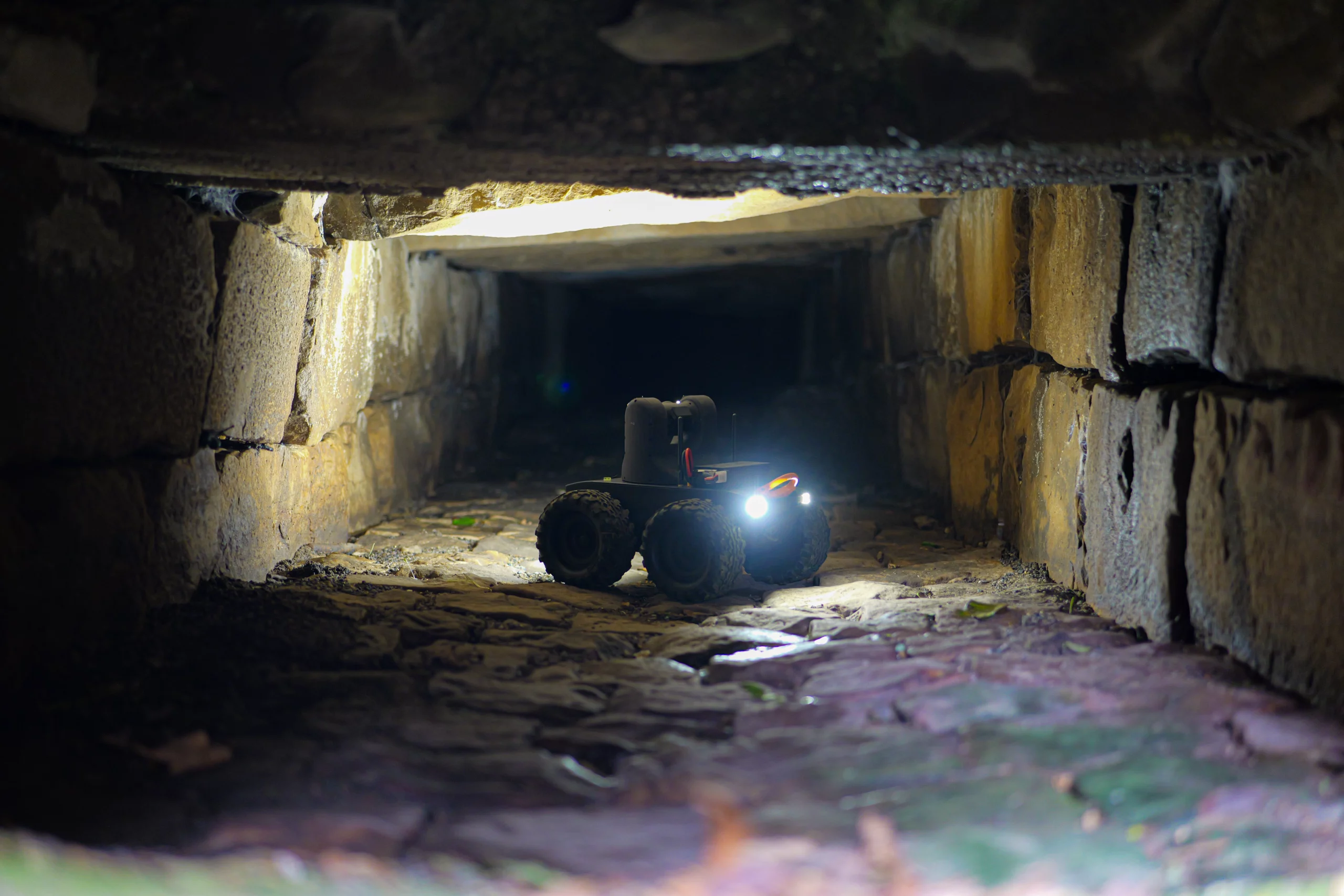
In this context,televisual inspection (TVI ) has established itself as a modern method of visual inspection of sewer networks. Thanks to state-of-the-art equipment-robots (Roview2), high-definition cameras and automated solutions, it is possible to carry out precise diagnostics without demolition, optimizing interventions and guaranteeing safety, efficiency and durability. This article explores the principle of ITV, its ability to detect anomalies, and its practical applications and best practices.
ITV inspection: how it works
ITV (Inspection TéléVisuelle) involves inserting a camera or robot equipped with a visual system into a pipe or sewerage system to film the inside of the structure, assess its condition and detect functional or structural defects.
There are several stages:
- Preparation and identification: identification of access manholes, verification of access, possible preliminary cleaning to clear deposits.
- Equipment deployment: camera on motorized cart or robot, depending on the diameter and configuration of the network. For example, inspection can be carried out via a camera cart that moves inside large pipes, or via a robot for partially filled pipes.
- Inspection and recording: the camera films 360°, illuminates the wall, records video, photos and metadata (distance, diameter, defects). Standards such as NF EN 13508-2+A1 apply.
- Analysis and report: the data is analyzed, and a report is produced with codification of anomalies, precise location and recommendations.
This method offers major advantages: it's non-destructive, fast, safer (reducing human entry into risky environments) and cost-effective, since it precisely targets interventions.
Detecting and preventing faults
One of the strengths of ITV is its ability to detect anomalies at an early stage, enabling targeted maintenance to be planned and costly stoppages or breakdowns to be avoided.
Here are a few examples of typical anomalies:
- Assembly anomalies: dislocations, disjointed joints, spaced fittings.
- Geometric anomalies: counter-slope, change in cross-section, ovalization, subsidence.
- Waterproofing defects: infiltration of parasitic clear water, exfiltration, cracks.
- Structural deformation: crushing, partial collapse, corrosion, deterioration of coatings.
- Obstructions and deposits: sand, sludge, roots, foreign objects, grease.
By detecting these faults at the inspection stage, operators can decide whether to clean up, carry out localized repairs, rehabilitate or schedule replacement. This reduces intervention costs and extends the network's lifespan. As Multinnov emphasizes: "Investing in TV diagnostics means betting on safety, savings and efficiency".
Practical applications and best practices
Concrete applications
- Urban sewers: using a camera on a cart or a robot, we inspect buried sections under the roadway without stopping traffic.
- Private connections: push cameras or handheld robots for small diameters to check connections, infiltrations and roots.
- Lift stations, inspection chambers: the ITV can be used to estimate the condition before maintenance or after cleaning.
- Industrial sites and confined environments: networks under service, complex networks requiring robotization or remote operation.
Best practices
- Rigorous planning: knowledge of dimensions, access, suitable equipment.
- Pre-cleaning to ensure proper visibility.
- Choice of suitable equipment: camera on cart for large diameters, robot for difficult conditions.
- Systematic video + photo recording, follow-up report coded according to standards.
- Quick analysis and feedback for immediate action.
- Equipment maintenance: check camera, lighting, cart and robot systems to avoid wasting time.
By applying these best practices, wastewater system operators maximize the safety, efficiency and economy of their operations.
Televisual inspection (TVI) of wastewater networks is a key component of preventive maintenance today. It makes it possible to rigorously monitor the internal condition of pipes, detect structural or functional anomalies, plan targeted actions and control costs. Thanks to technological advances - inspection robots, 360° cameras, mobile solutions - ITV is becoming more accessible, more reliable and faster. For sanitation professionals, it represents a powerful lever: enhanced safety, infrastructure durability, substantial savings. At the heart of this revolution are players such as Multinnov are at the heart of this revolution, developingvisual inspection solutions adapted to complex environments, demonstrating French innovation in this field.
In short, for a high-performance wastewater network, ITV is no longer a luxury, but a strategically profitable necessity.