
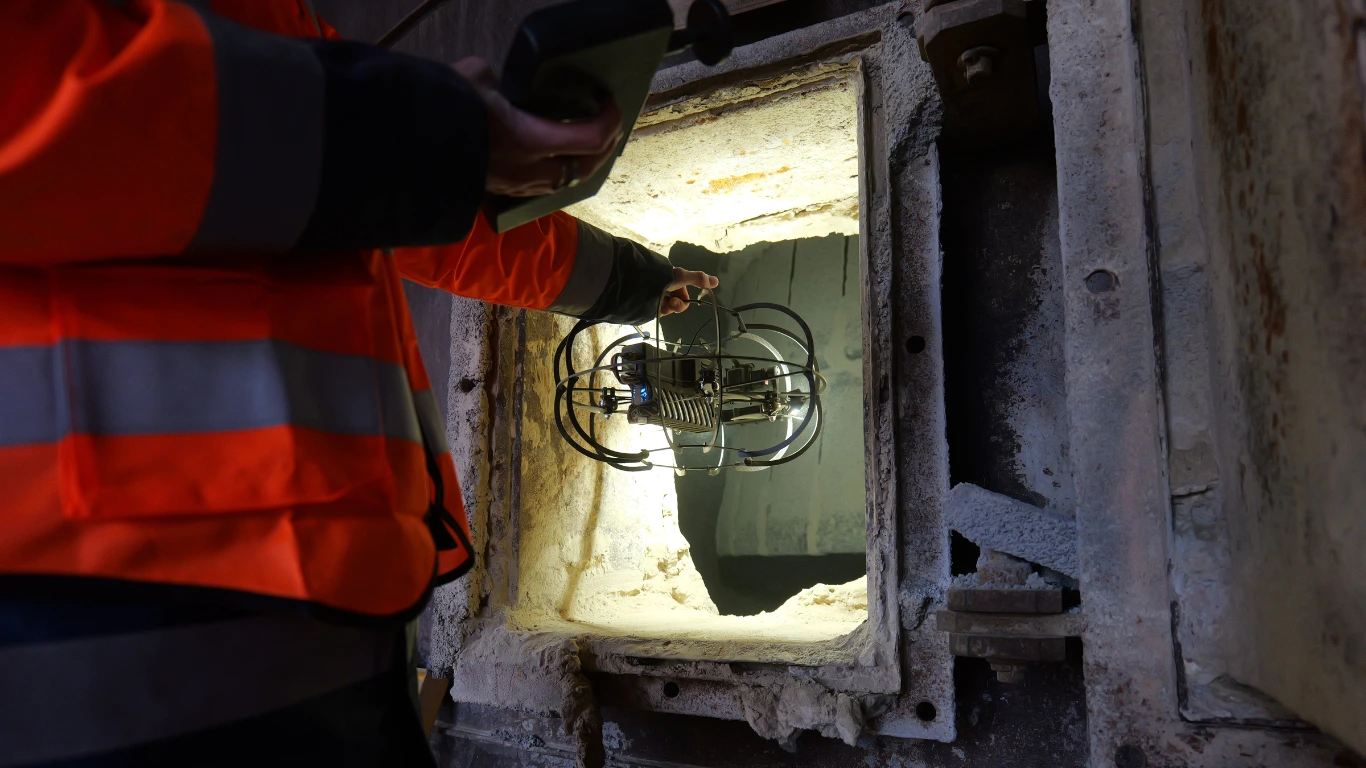
Inspection of industrial infrastructures and installations is an essential part of preventive maintenance. Yet some areas remain difficult to access - indoors, confined, obscure, cluttered - and pose significant risks for operators. This is where specialized indoor drones come in, able to penetrate complex spaces with agility, and collect precise visual data in conditions where traditional techniques fail.
In this article, we explore why the use of indoor inspection drones is becoming an industry standard, how they work, what their applications are, and why innovation expertise (for example at Multinnov) is a differentiating factor. We'll also look at the technical challenges involved in ensuring reliability and safety in these hostile environments.
Drones as an innovative solution
What is an indoor inspection drone?
An indoor drone is a UAV designed to operate in GPS-free environments, in indoor or confined infrastructures. To be operational, it must combine several technologies: distance sensors (ultrasonic, lidar, stereo camera), stabilization systems, assisted flight modes, and mechanical protection (cages, robust structure).
These drones are gradually replacing manual or scaffold-based inspections, as they can penetrate tanks, silos, pipes, reservoirs or industrial buildings, without endangering operators.
The technical challenges of indoors inspections
Flying a drone indoors is no trivial matter. A number of technical constraints make it demanding:
- Lack of reliable GPS: In confined spaces, GPS signals are either absent or too degraded to ensure stable positioning. We have to compensate by fusing visual and inertial sensors (camera + IMU) to estimate position.
- Obstacle and dynamic avoidance: The drone needs to detect obstacles in real time (walls, pipes, cables) and adjust its trajectory. Adaptive planning algorithms are being researched in the literature to manage partially unknown environments.
- Dust and particles: on indoor sites, the dust raised by the drone sometimes disturbs the cameras by focusing on particles rather than the surfaces being inspected.
- Difficult lighting : darkness, reflections or poorly lit areas require powerful, scalable LED systems, often on-board the drone.
- Structural protection: In confined environments, collisions are frequent. Protective cages or shells are needed to absorb shocks, without making the machine too heavy.
- Autonomy and energy management: Indoor flights are often short, but autonomy must be sufficient to carry out useful missions. Some models use tethered power to guarantee long missions without the risk of mid-air failure.
Multinnov's Stereo2 drone: an example of an indoor solution
A good example of a professional indoor drone is the Stereo2 from Multinnovdesigned for visual inspection in confined spaces. Its features demonstrate the capabilities required in this field:
- 4K camera with pre-configured fixed focus to prevent dust losses
- Adjustable LED lighting projects a low-angled light onto surfaces to reveal irregularities
- Stabilized flight in complex environments, optimized inspection even in difficult areas
- Used for inspections of containers, silos, tanks, industrial facilities, with feedback from the field
Stereo2 embodies the innovation needed to make indoor inspections safe, reliable and efficient.
Applications and benefits
Typical areas of application
Indoor drones are used in a wide range of sectors:
- Tanks, reservoirs, silos, industrial vats: internal inspection without emptying or dismantling.
- Factories, industrial sites: inspection of interior structures, technical ducts, halls, piping.
- Construction sites and tunnels: checking vaults or restricted passages.
- Power plants, boiler rooms: monitoring ducts, high or hard-to-reach areas.
- Aeronautical infrastructure: inspection of hangars, internal aircraft structures (e.g. Donecle).
The indoor drone market is growing fast: valued at ~ 5.98 billion USD in 2024, it could reach ~ 17.93 billion by 2032, with an annual growth rate of around 16.98%.
Benefits for operators and managers
- Increased safety: no need for human operators to enter hazardous areas.
- Time savings: inspections that used to take hours or days can now be carried out in just a few dozen minutes.
- Early detection of anomalies: cracks, corrosion, weld defects, infiltration are precisely identified visually.
- Cost optimization: reduced scaffolding costs, maintenance downtime, labor.
- Traceability and visual history: recorded data enable comparisons over time and the planning of targeted interventions.
Practitioners report that visual inspection in previously inaccessible interior areas is now possible with Stereo2, significantly reducing the total cost and duration of inspections.
Return on investment and economies of scale
Although the initial investment for a professional indoor drone is not negligible, the savings in human intervention, production downtime and risk very quickly compensate. What's more, as the market becomes more democratic, costs fall, encouraging industrial adoption.
Compulsory expertise and innovation
Software design and sensor fusion
The heart of an efficient indoor drone lies in its ability to estimate its position without GPS, via the fusion of visual and inertial data (slamdrones, visual odometry). Algorithms must be robust to withstand disturbances (dust, reflections, shadows).
Recent work presents adaptive frameworks for trajectory planning in partially unknown environments, enabling the drone to adjust in real time to unforeseen obstacles.
Dust-proof and robust
An indoor drone must be able to withstand adverse conditions (dust, particles, projections). The Stereo2 uses a fixed focus to prevent dust from affecting aiming.
Some competitor drones, such as the Terra Xross 1, incorporate a tethered power module for extended flight in demanding environments.
Safety and structure
To fly in confined spaces, drones need to be equipped with protective cages, collision controls and safe shutdown systems. The rotor must be protected to avoid environmental damage or accidents.
Homeland security regulations require that UAVs weighing more than 55 lb (approx. 25 kg) are not allowed indoors, and that the range of obstacle detection sensors is adapted to the restricted environment.
Steering expertise and training
Even though many indoor drones can operate semi-autonomously, an experienced operator is still essential: he or she must anticipate behavior, control trajectory, adjust lighting and react to unforeseen events.
Companies like Multinnov provide not only the equipment (Stereo2), but also training, technical support and software updates to guarantee reliable missions.
AI integration and future automation
The future of indoor drone inspection lies inartificial intelligence, capable of automatically detecting anomalies (vision algorithms, machine learning) and autonomously guiding the drone.
The market is moving towards systems combining vision + LiDAR + AI to offer autonomous, adaptive and precise inspection.
Research is proposing adaptive frameworks combining global planning and local adaptation for inspections in partially unknown environments, which is crucial for industrial sites undergoing constant change.
Indoor drone inspection opens up major prospects for industry. Where traditional methods struggle (confined areas, dangerous conditions, heavy costs), specialized drones enable efficient, safe inspection with previously unattainable precision.
With technologies like Multinnov'sStereo2, featuring 4K cameras, scalable LED lighting and a structure optimized for confined environments, visual inspection becomes an agile and reliable process. These innovations require a high level of technical expertise: sensor fusion, robustness, safety, on-board algorithms, pilot training and the move towards autonomy via AI.
For industrial managers, infrastructure operators or logisticians, integrating an indoor drone into their inspection strategy means investing in safety, performance, cost reduction and an advanced view of anomalies. The market itself is following this trend: the size of the indoor inspection drone market is expected to grow from ~ 5.98 billion USD in 2024 to nearly 17.93 billion by 2032.
By leveraging innovation, local expertise and sovereign technology, indoor drone inspection becomes an essential competitive advantage for those who dare to modernize their processes.