Inspecting industrial infrastructure is never a trivial matter. When work must be performed inside a tank, tunnel, utility shaft, chimney, or confined space, the challenges multiply: difficult access, poor visibility, risks to operators, lengthy preparation, and high logistical costs. The use of drones simplifies these operations by improving the safety and speed of inspections.
At Multinnov, we develop indoor drone and inspection robot solutions to address these on-site challenges. Our goal is simple: to enable professionals to perform reliable, fast, and safe visual inspections in the most complex environments.
With the Stereo3, our next-generation indoor inspection drone, we offer technology designed to go where humans cannot—or should no longer—take risks.
Overview of Multinnov's Drone Solutions
Our product line consists of complementary solutions designed forvisual inspection and industrialnon-destructive testing. The Stereo3 is the indoor drone designed for inspecting confined spaces, while the Roview3 is specifically designed to meet the needs of video inspection in pipes and sewer systems.
This complementarity makes it possible to choose the right tool for each environment.
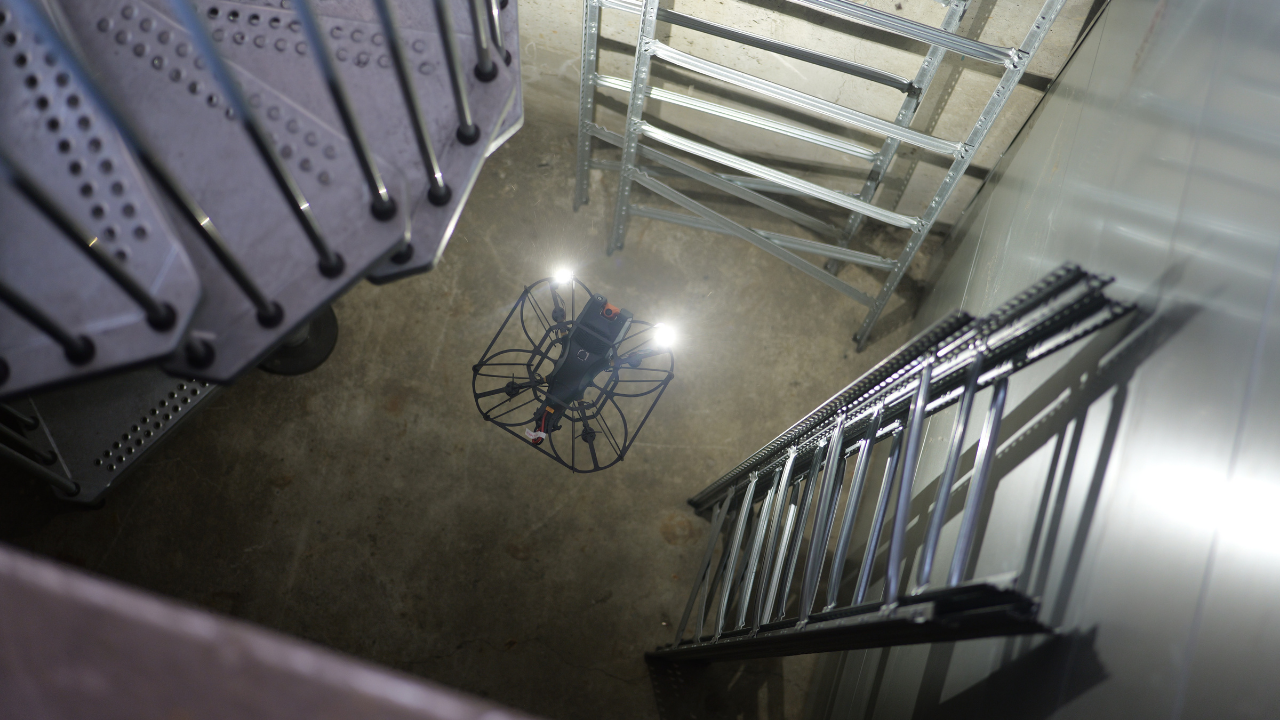
The Stereo3 was designed to operate in enclosed spaces without GPS. It features a dual-camera optical stabilization system capable of analyzing the environment in real time to provide a stable visual experience, even in challenging conditions.
This indoor drone also features a 4K camera, 1080p video feed, 13,000-lumen lighting, a carbon fiber frame, and wireless control. The official product page lists its flight time as 12 minutes.
These features address a key challenge: quickly obtaining a clear, stable, and usable image in an environment where human access is limited.
The Roview3, on the other hand, is our wireless pipe inspection robot. It features a 4K camera, 16,000-lumen lighting, a battery life of over two hours, full waterproofing, buoyancy, and wireless control.
Applications and use cases in confined spaces
Indoor drones meet a wide range of needs inindustry. They are particularly useful in situations where inspections traditionally require heavy equipment: scaffolding, rope access technicians, aerial work platforms, lengthy lockouts, or human entry into confined spaces.
The Stereo3 can be used to inspect:
- tanks and reservoirs;
- silos;
- tunnels and utility tunnels;
- industrial chimneys;
- metal or concrete structures;
- energy facilities;
- certain environments in the nuclear industry.
In these situations, drones can be used to conduct an initial visual survey, identify anomalies, and document the condition of infrastructure.
These applications are practical: identifying a crack, checking for corrosion, examining a deposit, assessing the condition of a coating, inspecting a high-altitude area, or preparing for maintenance work.
We position the indoor drone as a decision-making tool. It does not replace the expertise of technical teams, but it quickly provides them with visual data that helps them take action in the right place at the right time.
In underground networks and pipelines, the Roview3 complements this approach. While the indoor drone operates in open spaces, the inspection robot can navigate through pipes, film the interior of the networks, and document sewer defects.
Benefits and Challenges of Drone Inspections
The primary benefit of indoor drone inspections is safety. By sending a drone into hard-to-reach areas, operators remain at a safe distance. This limits their exposure to the risks associated with confined spaces: falls, hazardous atmospheres, poor visibility, obstacles, or unstable environments.
This approach is at the heart of what we do.
Drone inspections also save time. In many cases, they eliminate the need to immediately deploy heavy-duty access equipment. Visual inspections can be initiated more quickly, with minimal logistical requirements.
The benefits for manufacturers are numerous:
- less preparation;
- less human exposure;
- fewer extended stops;
- visual data that can be used directly;
- improved traceability of inspections;
- more targeted maintenance.
From an economic standpoint, the impact can be significant. Multinnov notes that its drone- and robot-based video inspection solutions reduce the time required for preparation compared to certain traditional methods, such as scaffolding, and can help lower project costs.
Data quality is another key factor. A successful inspection must produce stable, clear, and usable images. With its stereoscopic stabilization, 4K camera, and powerful lighting, the Stereo3 helps teams document observed anomalies with greater precision.
This visual data can then be used to prioritize maintenance tasks, plan scheduled downtime, and generate maintenance reports.
The challenge, therefore, is not just about moving faster. It is about gaining a better understanding of the actual condition of the infrastructure, with fewer risks and better cost control.
Indoor drone inspections are meeting a growing demand from manufacturers: to access complex environments without unnecessarily exposing operators, while collecting reliable data for maintenance purposes.
With the Stereo3, we offer an indoor drone designed for confined spaces, equipped with optical stabilization, a 4K camera, powerful lighting, a carbon fiber frame, and wireless control. With the Roview3, we round out this solution for pipes and sewer systems.
At Multinnov, we design these solutions to makevisual inspection safer, more efficient, and more accessible. Our goal is to help professionals modernize their inspection processes, reduce on-site risks, and sustainably improve the performance of their inspection operations.