
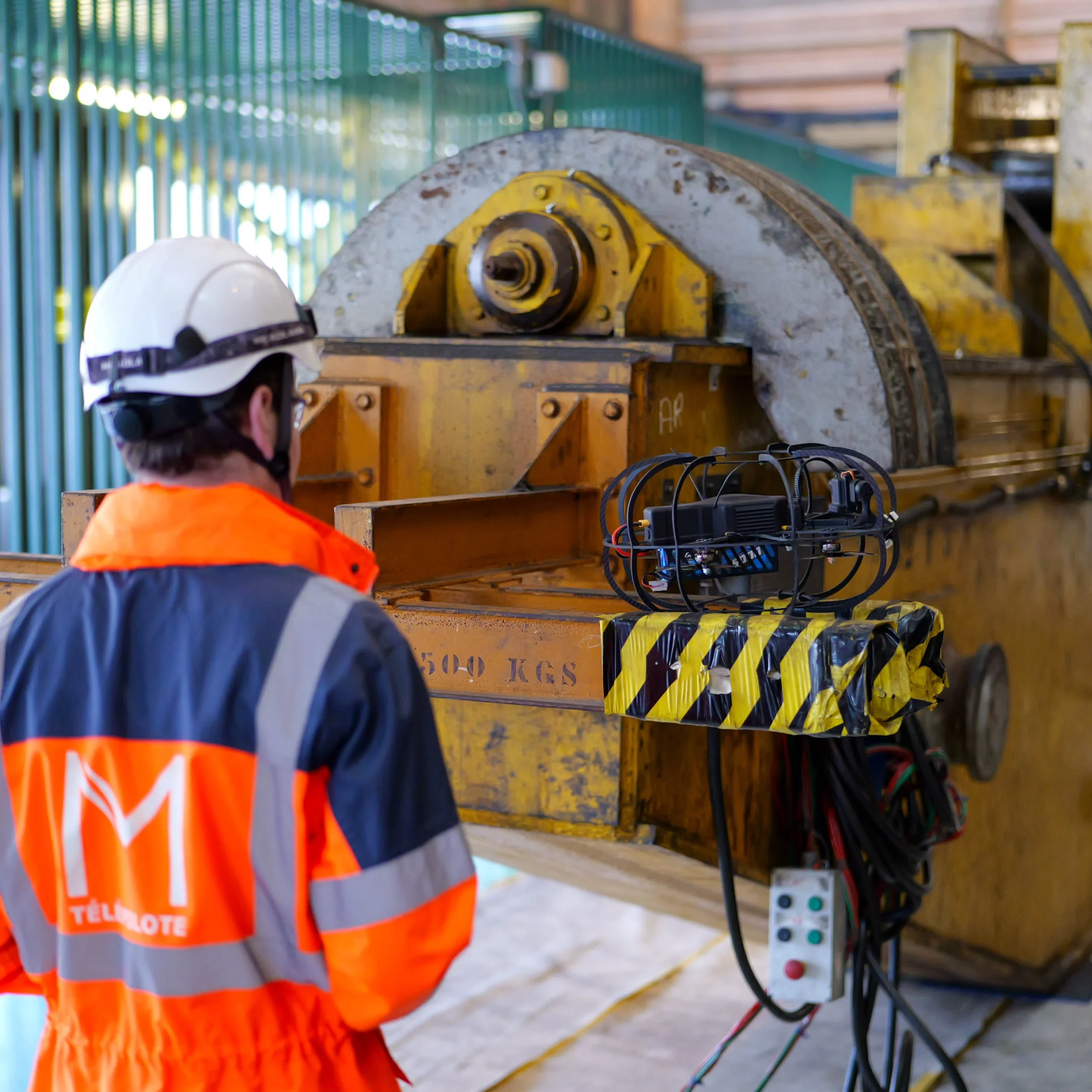
Nuclear power plants are among the most sensitive and complex infrastructures in the world. Every maintenance or inspection operation is subject to strict protocols, dictated by safety, security and performance imperatives. In a world where the slightest structural or material defect can have major consequences, technological innovation becomes a strategic lever.
Among the growing number of tools available in the nuclear sector, the inspection drone has established itself as a reliable, precise and safe solution. Thanks to models such as the Roview2 or the Stereo2designed by Multinnovvisual inspection of confined spaces has reached a new level. Not to replace human operators, but to enable them to intervene with greater safety, speed and precision.
The challenges of nuclear inspections
A high-risk environment
Inspecting a nuclear power plant means working in an environment where every second of exposure, every meter traveled or every technical action can present a risk to human health or the integrity of the installations. The areas inspected may be :
- highly irradiated,
- confined, narrow and difficult to access,
- structurally sensitive (reactors, cooling basins, technical ducts).
It is therefore essential to limit staff exposure, without compromising diagnostic accuracy.
Extreme precision requirements
Nuclear inspection does not tolerate approximation or error. These are :
- spot micro-cracks or weld defects,
- check the integrity of tanks, piping, welds and walls,
- visually inspect areas that are normally inaccessible (underfloor, technical ducts, spacers).
These operations require high-definition imaging, impeccable stability, and fast, reliable data transmission.
The role of drones in inspections
An operational revolution
The use of drones in industry is not new, but their use in nuclear environments has long been hampered by technical constraints (radiation, electromagnetic interference, restricted space). However, recent advances have enabled indoor inspection robots to establish themselves as reliable allies.
Multinnov offers two particularly well-suited models:
- The Stereo2indoor stabilized drone, designed for confined spaces, with stereo optical sensors and powerful lighting.
- The Roview2is a remote-controlled or autonomous ground robot capable of navigating narrow, partially submerged pipes and technical galleries.
Targeted, safe interventions
Thanks to their compactness, agility and on-board technology, these drones can :
- navigate in closed environments without GPS,
- film in 4K or infrared, as required,
- map the environment in real-time 3D,
- access to areas where humans cannot physically or legally intervene (e.g. irradiated zones).
This makes visual inspection faster, safer and more comprehensive.
Customizable on-board sensors
Another major advantage is the ability to embed customized payloads:
- thermal or multispectral sensors,
- temperature or radioactivity probes,
- dimensional or vibration measurement tools,
- panoramic video capture systems.
In this way, each intervention can be tailored to the type of diagnosis required, without overloading the procedures.
Benefits and prospects
Time savings and service continuity
One of the biggest constraints on power plants is the length of time they are out of service. Every day without production represents a major economic loss. The use of drones reduces :
- preparation time (no scaffolding to erect),
- intervention times (rapid inspection, centralized data),
- diagnosis times (immediate or delayed video analysis).
Some sites, such as those of EDF, Orano and Framatome, are beginning to standardize the use of indoor drones in their maintenance and expertise operations.
Savings on human and material resources
Fewer exposed personnel = less risk of accident or additional PPE costs. Drones also make it possible to avoid :
- heavy equipment rental (cherry pickers, scaffolding),
- operations in restricted environments (rope access technicians, teams working in irradiated environments).
An inspection robot costs little to run, and pays for itself quickly when shared over several inspections a year.
Enhanced safety
Each drone mission reduces exposure to physical and radiological risks. What's more, the quality of the data collected enables faster decision-making, avoiding late corrective action, which is often more complex and costly.
Complementarity, not replacement
Contrary to popular belief, drones do not replace inspection staff: they enable them to go faster, further and safer. It's an extension of their analytical capacity, a technological extension of their expertise.
French technology at the heart of industrial sovereignty
In a tense geopolitical context, and given the challenges of technological sovereignty, using drones developed in France is becoming a strategic lever. Multinnov designs and assembles its products in France, guaranteeing :
- complete traceability of components,
- local, responsive support,
- compatibility with French and European safety standards,
- reduced dependence on imports.
This is particularly crucial for sensitive installations such as nuclear power plants, where confidentiality and technological robustness are non-negotiable criteria.
Nuclear power plant inspection is entering a new era. Thanks to solutions like the Roview2 and Stereo2drones are becoming essential tools for combining safety, efficiency, precision and economy. Without replacing human operators, they assist them in complex, repetitive or risky missions, while providing unrivalled analysis quality.
Democratizing their use in the nuclear world, Multinnov is committed toresponsible innovation, in the service of industrial safety and technological sovereignty. One thing is certain: the future of nuclear inspection will involve these new robotic allies, capable of seeing where humans cannot, without ever losing sight of the essential - the safety of all.