
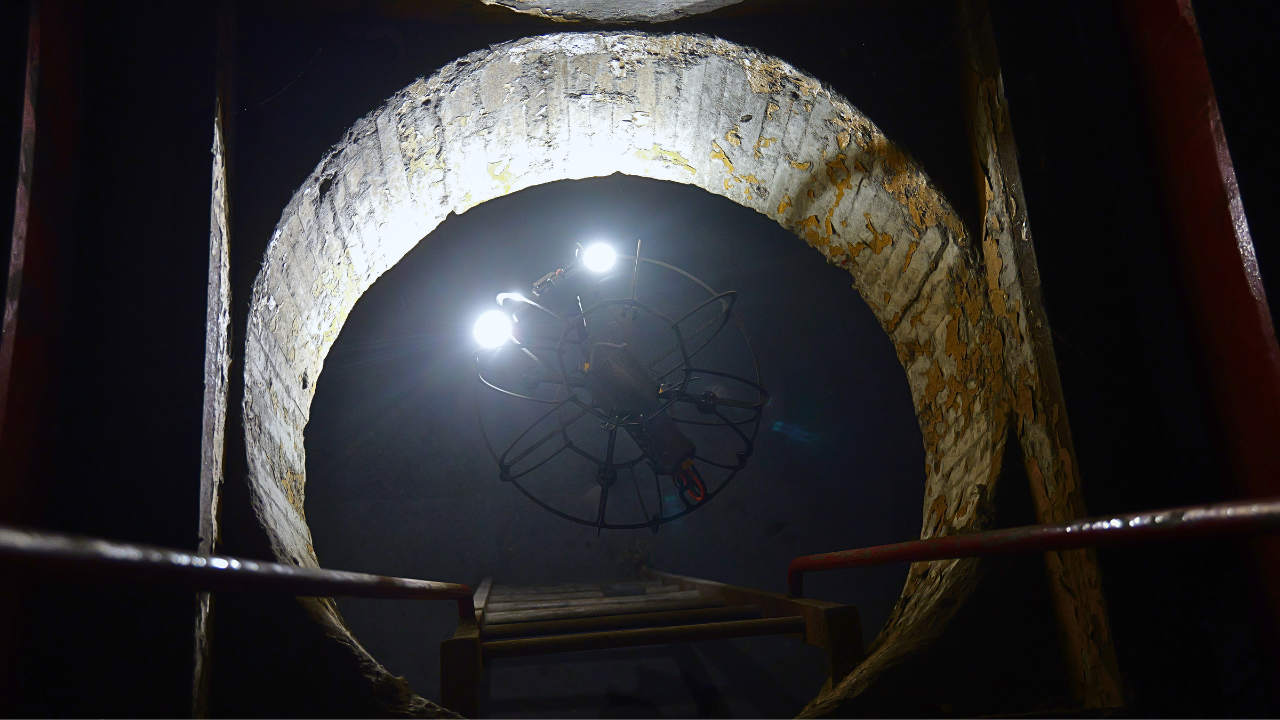
In many industrial sectors—chemical, energy, infrastructure, sanitation, and nuclear—inspecting confined spaces is a major challenge. These environments, defined by their restricted access, darkness, and often dangerous conditions, require precise, safe, and effective means of investigation. Traditionally, these operations involved human entry or the use of heavy, expensive, and dangerous equipment. Today, indoor drones, such as Multinnov'sStereo2, are emerging as an innovative solution capable of transforming these inspections by combining safety, performance, and a wealth of collected data.
Exploring the inaccessible – opportunities in confined spaces
Confined spaces include all environments with restricted access, space, and visibility—tanks, silos, technical ducts, pipes, tunnels, or reservoirs. In these areas, manual work is often risky for operators: access equipment that is difficult to install, the need for respiratory protection, or the risk of exposure to toxic or oxygen-deficient atmospheres.
In addition to the human risks, these inspections are typically time-consuming, costly, and disruptive to normal facility operations. For example, inspecting a tank or pipeline may require draining, scaffolding, or temporarily closing sections of the site. According to industry studies, the use of drones in confined spaces can reduce intervention costs by up to 90% compared to traditional methods, while improving the efficiency and frequency of inspections.
Stereo2 – technology and performance for precision
Faced with these challenges, the Stereo2 developed by Multinnov is specifically designed to meet inspection requirements in confined and complex environments. Its technology and features make it a tool suited to environments where precision, safety, and efficiency are paramount.
Controlled navigation in the dark
The Stereo2 is an indoor drone without GPS, stabilized by a stereoscopic camera and optical odometry. This allows it to fly in a stable and controlled manner in environments without GPS signals, where conventional autonomous navigation is impossible.
Its compact size (approximately 39 cm in diameter) and carbon protective cage ensure increased robustness in the event of contact with walls or obstacles, which is common in narrow tunnels or galleries.
High-resolution imaging and high-performance lighting
One of the strengths of Stereo2 is its high-definition 4K camera, capable of capturing high-precision videos and photos. The images obtained can be used to detect structural defects, cracks, or deposits that would be invisible to the naked eye or with standard cameras.
To compensate for the frequent darkness of confined spaces, it is equipped with a powerful LED lighting system (up to 10,000 lumens). This device provides uniform illumination of the inspected surfaces and identifies even the most subtle anomalies, even in very dark or dusty areas.
Real-time transmission and data collection
The Stereo2 has a robust radio link that transmits Full HD video in real time, as well as telemetry data allowing the operator to track the flight and inspection minute by minute.
It is also possible to access flight logs, which facilitates analysis, traceability, and the creation of structured inspection reports for maintenance or regulatory compliance.
Photogrammetry and advanced 3D modeling
In addition to simple visual capture, the images collected by Stereo2 can be used with specialized software to create photogrammetric 3D models of the inspected environment, making data interpretation even more intuitive and accurate.
Leveraging your inspections – from data to decision
Increased safety for operators
One of the most immediate benefits of Stereo2 is that it keeps operators out of hazardous areas. Instead of physically entering confined spaces, which may be exposed to toxic atmospheres or lack oxygen, teams operate the drone remotely, drastically reducing the risk of accidents.
Increased efficiency and reduced costs
By replacing slow and costly traditional inspections with fast, documented flights, companies can reduce overall inspection costs, limit production downtime, and increase the frequency of checks without interrupting normal site operations.
The drone's agility also allows access to areas that cannot be easily reached using conventional methods—for example, under complex structures, inside ducts, or at the top of vertical tanks—without requiring dismantling or installation of temporary structures.
Accurate visual diagnostics for proactive maintenance
The use of high-resolution cameras combined with appropriate lighting enables highly detailed visual diagnostics, which are essential for identifying emerging faults or areas at risk before they require major intervention.
Integrating data into decision-making or predictive maintenance tools improves asset management and optimizes maintenance schedules, thereby reducing costs and the risk of unexpected downtime.
Inspecting confined spaces is a real technical and human challenge for many industries. Thanks to innovative solutions such as Multinnov'sStereo2, it is now possible to meet these needs with a high level of safety, precision, and efficiency.
By enabling controlled navigation in confined spaces, high-quality visual data collection, and real-time transmission, Stereo2 helps professionals make informed decisions while reducing the human risks and costs associated with traditional inspections.
For facility managers, maintenance engineers, and infrastructure managers, investing in this technology represents a strategic step forward in modernizing inspection processes, increasing operational performance, and ensuring the safety of industrial sites—regardless of the challenges of access or the complexity of the spaces to be inspected.