
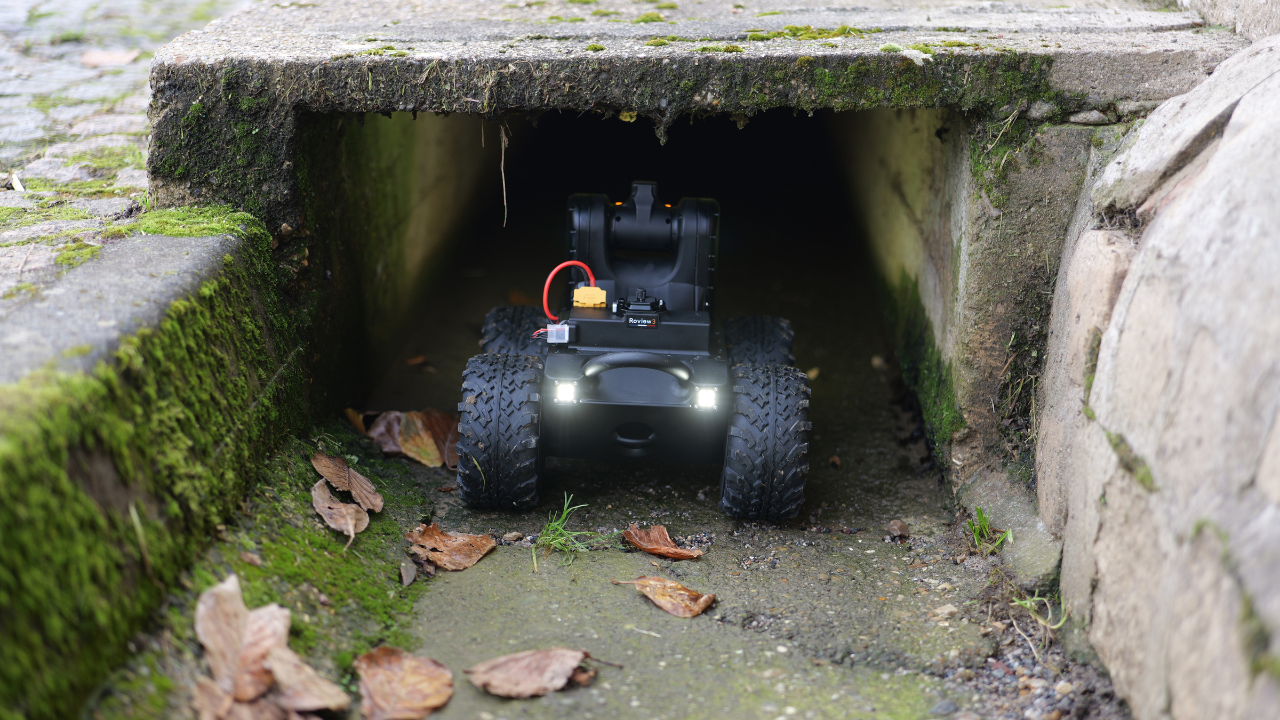
In many industrial sectors, visual inspection of infrastructure is a key step in ensuring the safety, compliance, and performance of facilities. However, when it comes to confined spaces—such as tanks, pipes, silos, or tunnels—these operations quickly become complex, costly, and risky.
In light of these challenges, the solutions developed by Multinnov stand out as a true innovation. Thanks to the use of drones and inspection robots such as the Roview3, professionals now have tools capable of fundamentally transforming CCTV inspection methods, while improving safety and efficiency.
The Challenges of Inspections in Confined Spaces
Confined spaces are areas that are difficult to access, often narrow, dark, and potentially hazardous. They are found in many industrial settings, including sewer systems, power plants, chemical facilities, and nuclear sites.
The main challenge lies in accessibility. Some areas are simply impossible for a technician to reach without deploying heavy equipment such as aerial work platforms, rope access technicians, or specialized equipment. In some cases, human intervention is completely out of the question.
Added to this are conditions that can sometimes be extreme: lack of oxygen, the presence of toxic gases, humidity, corrosion, or virtually zero visibility. These factors significantly increase the risks for operators and require strict safety protocols, which are often time-consuming and costly to implement.
Finally, traditional inspection methods have limitations in terms of accuracy and speed. They often involve production downtime and time-consuming procedures, which directly impact the profitability of industrial operations.
Drones as an innovative solution
It is in this context that the inspection drones developed by Multinnov offer a practical and effective solution. Designed to operate in complex environments, this equipment enables visual inspections to be carried out without exposing operators to danger.
Drones are capable of navigating narrow, winding spaces where conventional equipment reaches its limits. Equipped with high-definition inspection cameras and advanced sensors, they provide a real-time view of the interior of structures.
This ability to explore is essential: it allows for the collection of accurate data that can be used immediately for diagnostics. The images and videos captured can be used to detect anomalies such as cracks, corrosion, or blockages, thereby facilitating preventive maintenance.
Embedded technologies also make it possible to go a step further. Some solutions incorporate 3D modeling or photogrammetry systems, providing an accurate representation of the structures being inspected. This significantly improves our understanding of the issues at hand and aids in decision-making.
Furthermore, unlike traditional methods, drone inspections do not always require operations to be shut down. This is a major advantage for manufacturers, who can continue their operations while conducting inspections.
Tangible benefits for safety and maintenance
One of the main advantages of drones is that they improve safety. By eliminating the need to send operators into hazardous environments, they significantly reduce accidents associated with work in confined spaces.
This increase in safety goes hand in hand with improved operational efficiency. Drones make it possible to quickly inspect large areas or complex zones, thereby reducing response times. Depending on the application, an inspection can be completed in just a few minutes, whereas a human-led operation would have taken several hours or even several days.
From an economic standpoint, the benefits are also significant. Fewer personnel required, less heavy equipment, and fewer production stoppages: the use of drones helps significantly reduce inspection costs.
The quality of the data collected is another major advantage. Thanks to high-definition cameras and onboard sensors, inspections are more accurate and reliable. Issues can be identified earlier, allowing for proactive maintenance and helping to prevent costly failures.
In line with this approach, the solutions offered by Multinnov, particularly with the inspection robot Roview3, perfectly complement the use of drones. While drones excel at rapid aerial exploration, the inspection robot enables a more in-depth analysis of specific pipes or networks.
This synergy enhances the overall effectiveness of visual inspection operations and positions Multinnov as a key innovator in the industry.
Inspection in confined spaces is a major challenge for many industrial sectors. Given the technical constraints, safety risks, and economic pressures involved, traditional methods are now reaching their limits.
Drones have now become an indispensable solution. By combining accessibility, precision, and safety, they are transforming visual inspection practices and optimizing infrastructure maintenance.
With its innovative solutions, Multinnov is supporting this evolution by offering tools tailored to on-site requirements. The integration of drones and inspection robots such as the Roview3 paves the way for a new generation of ITV inspections that are safer, faster, and more efficient.
Adopting these technologies means choosing an industry that is more efficient, more secure, and firmly focused on the future.