Industrial inspection has long relied on demanding traditional methods: manual work at heights, access to confined spaces, and costly production shutdowns. While these approaches are still in use today, they are now showing their limitations in the face of modern challenges related to safety, performance, and cost optimization.
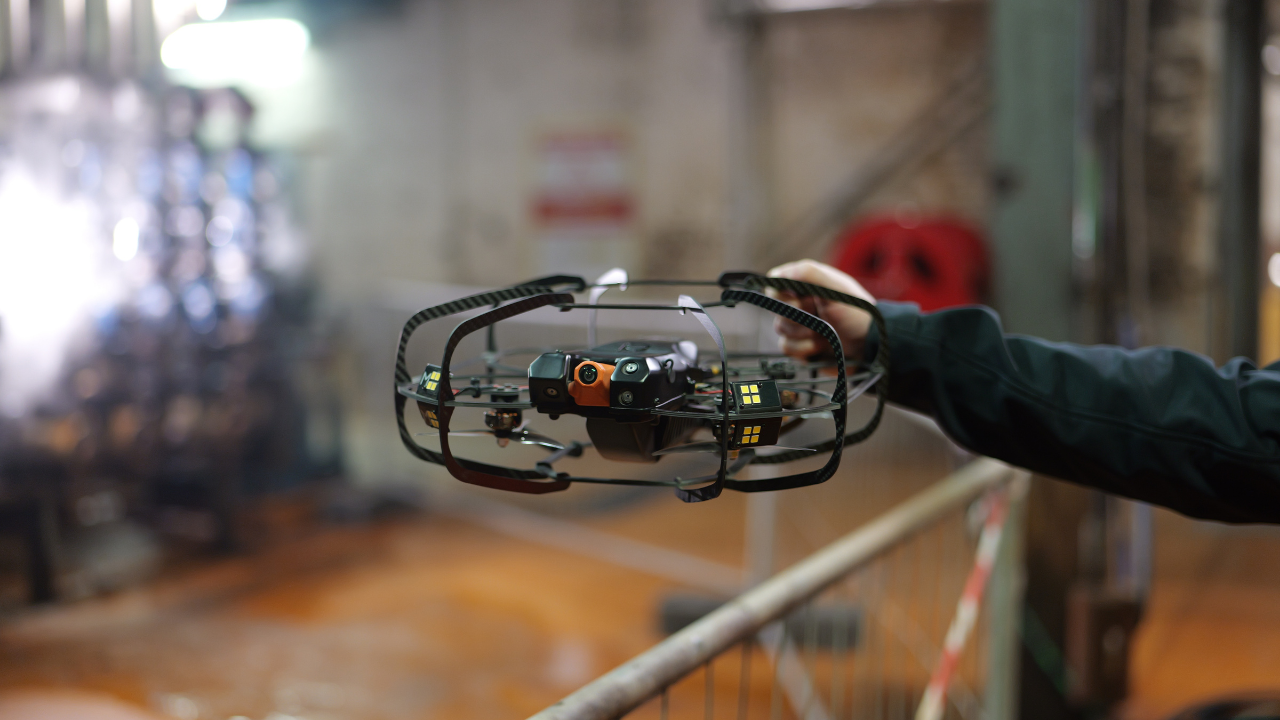
In this context, the rise of inspection drones marks a significant shift. Capable of quickly accessing complex areas, these technologies are redefiningvisual inspection practices across many industrial sectors.
However, despite this promise of innovation, certain constraints must be taken into account. Between regulatory requirements, technical limitations, and operational integration, the use of drones requires a well-managed approach.
Industrial inspection reimagined with drones
The introduction of drones intothe industry has fundamentally changed the way inspections are conducted. Their main advantage lies in their ability to access difficult or even dangerous areas without directly exposing operators to risk.
In industrial facilities, many areas remain difficult to inspect:
- high-rise structures
- closed facilities
- extensive technical infrastructure
- hard-to-reach areas
Drones make it possible to respond quickly in these environments, with minimal preparation.
This change is part of an overall effort to streamline operations. By reducing logistical constraints, inspections become easier to organize and less costly to carry out.
Tangible benefits for professionals
The use of drones offers several immediate benefits.
Enhanced safety
Operations in hazardous areas are limited. Operators remain at a distance, which significantly reduces the risks associated with inspections at heights or in confined spaces.
Time saving
Inspections can be carried out more quickly, without the need for heavy equipment such as scaffolding.
Operational efficiency
Drones make it possible to cover large areas quickly, thereby improving team productivity.
Data quality
Thanks to onboard inspection cameras, the images captured are accurate and can be used to analyze the condition of infrastructure.
Companies such as Multinnov are developing solutions specifically tailored to these industrial applications, incorporating technologies designed to operate in complex environments.
Technical and regulatory constraints: challenges to be addressed
Despite their many advantages, drones are not a one-size-fits-all solution. Their use in industrial settings requires taking several constraints into account.
Technical limitations to anticipate
Drones must operate in environments that can sometimes be challenging:
- no GPS signal
- low light
- presence of obstacles
- ventilation or dust conditions
These factors can affect flight stability and the quality of the data collected.
In confined spaces, these challenges are even more pronounced. Drones must be specifically designed to operate without external assistance, equipped with appropriate navigation systems.
A regulatory framework to be followed
The use of drones is subject to strict regulations, particularly regarding safety and the protection of people.
Even in an industrial setting, certain rules must be followed:
- operator training
- flight clearances by zone
- compliance with safety procedures
These requirements may vary by country and industry, which calls for careful planning.
Integration into industrial processes
One of the major challenges lies in integrating drones into existing processes.
Companies must adapt their methods to take full advantage of these technologies:
- team building
- Adaptation ofCCTV inspection protocols
- management of collected data
Without this integration phase, the benefits of drones may be limited.
Added value and future prospects
Despite these limitations, drones are now a key driver of transformation in industrial inspection.
Their ability to collect data quickly and securely makes them particularly well-suited to today's demands.
Better decision-making
Data from inspections makes it possible to quickly identify issues and prioritize corrective actions. This contributes to more effective infrastructure management.
Cost reduction
By reducing the need for human intervention and heavy equipment, drones enable significant cost savings in inspection operations.
Complementarity with other technologies
Drones do not completely replace inspection robots or traditional methods. They complement these solutions by providing additional flexibility.
This synergy makes it possible to address a wide range of situations, depending on the constraints on the ground.
Significant opportunities for innovation
The sector continues to evolve rapidly, particularly with the integration of new technologies:
- artificial intelligence for image analysis
- more advanced sensors
- autonomous navigation
These advances should further improve the accuracy and effectiveness of inspections.
In this context, companies such as Multinnov play a key role by developing solutions tailored to industrial needs, capable of meeting constraints while maximizing added value.
Drone inspection drones is now establishing itself as an essential solution for modernizing industrial practices. By providing rapid access to complex areas, it improves safety,efficiency, and the quality of inspections.
However, its implementation requires a careful approach. Technical, regulatory, and organizational constraints must be taken into account to ensure optimal use.
By combining technological innovation with a practical, on-the-ground approach, the solutions offered by Multinnov allow you to fully harness the potential of drones.
The challenge for manufacturers is no longer whether to adopt these technologies, but how to integrate them effectively to improve their performance in the long term.