The management and maintenance of wastewater networks and underground infrastructures represent a major challenge for local authorities and industry alike. Aging pipes, infiltrations, deposits, cracks or risks of collapse: the challenges are numerous, and their resolution depends on regular inspections.
Long carried out manually and intrusively, these operations have now been profoundly transformed by technology.Televised network inspection (TVI ) has become the benchmark method, offering direct, reliable visibility of the inside of pipes without having to open them or expose operators to unnecessary risks.
Through solutions such as Multinnov'sRoview2, combining robotics, high-definition imaging and innovation, ITV modernizes maintenance, enhances safety and optimizes network management costs.
Why modernize network inspection
Networks subject to severe constraints
Wastewater and drinking water networks are essential infrastructures for the smooth running of cities and industries. Their good condition conditions quality of life, health safety and the durability of installations. However, these networks are subject to :
- Natural wear and tear: corrosion of materials, sediment deposits, infiltration of groundwater.
- Overloads: flooding, industrial discharge, mechanical pressure.
- External stresses: ground movement, tree roots, pollution.
Without regular checks, the risks are manifold: burst pipes, flooding, pollution and even service interruptions.
The limits of traditional inspections
Historically, inspections were carried out by direct human intervention or using rudimentary tools. These practices have several drawbacks:
- Danger to operators: exposure to toxic gases, confined atmospheres, risk of accidents.
- Limited access: some network sections are too narrow or too deep to be explored.
- Inaccurate observations: subtle defects (fine cracks, micro-leaks) often go unnoticed.
- High costs: mobilization of specialized teams, plant downtime, long response times.
These constraints make it essential to adopt more modern, safer solutions.
TV inspection and drones: an innovative approach
What is ITV?
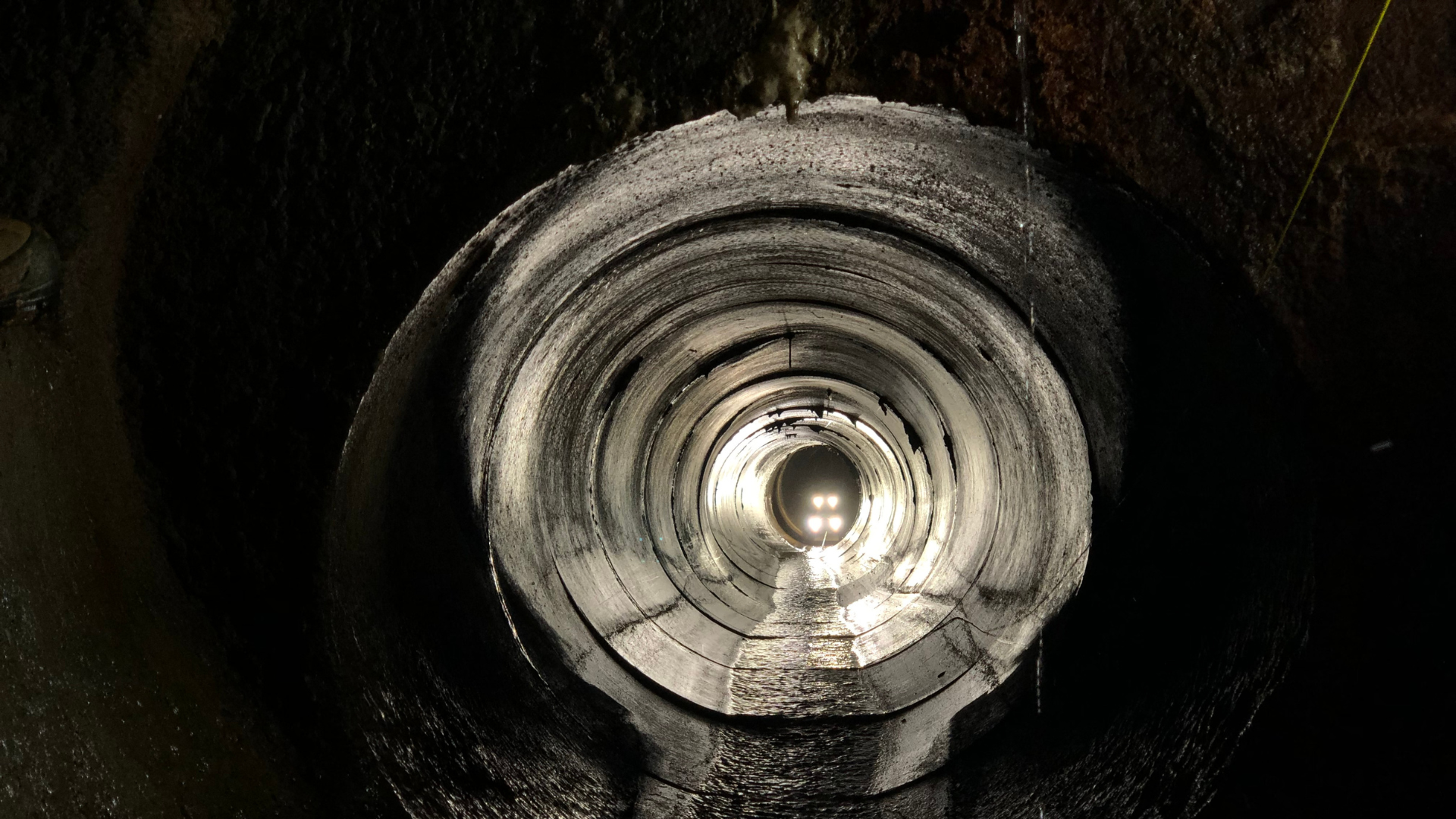
Televised network inspection (TVI ) involves inserting a robot equipped with a high-resolution camera into the pipe. Connected to a control unit on the surface, it transmits live, precise images of the pipe's interior. This technology makes it possible to :
- Visualize pipe status in real time.
- Detect cracks, obstructions, deposits or infiltrations.
- Map and archive data for historical tracking.
Today, ITV is the benchmark method for network diagnostics.
ITV robots and forklifts: precision in the service of maintenance
Among modern solutions, inspection robots such as Multinnov'sRoview2 offer exceptional maneuverability. This ITV truck is designed to maneuver through sewer networks partially filled with water, even over long distances. Its main assets:
- High-definition cameras to detect the slightest anomaly.
- Integrated lighting for dark environments.
- Immediate transmission of images to control teams.
- Smooth navigation even in congested or winding sections.
These features make it an essential tool for local authorities and companies specializing in network maintenance.
Drones, an innovative complement
While ITV forklifts remain the norm in pipelines, specialized drones (such as Multinnov's Stereo2 for confined aerial environments) are opening up new horizons. In tanks, galleries or spaces where wheeled robots cannot reach, these compact aircraft offer :
- 3D handling to explore every zone.
- Stabilized cameras for precise shots.
- The ability to limit human intervention in high-risk areas.
The combination of these technologies - ITV robots and drones - now represents a complete and innovative approach to inspection.
Concrete impacts and prospects for managers
Immediate benefits
The adoption of ITV and robotic solutions such as those from Multinnov leads to significant gains:
- Enhanced safety: operators no longer enter hazardous areas.
- Time-saving: rapid inspection, without heavy dismantling or prolonged downtime.
- Increased efficiency: precise detection of anomalies, enabling targeted repairs.
- Cost savings: reduced labor and downtime costs.
Better work planning
Thanks to the images collected and archived, managers can :
- Implement proactive maintenance.
- Prioritize interventions according to degree of urgency.
- Extend the life of networks by anticipating failures.
This approach fosters sustainable infrastructure management that meets today's economic and environmental challenges.
Development prospects
The future of TV inspection promises to be rich in innovation:
- Integrated smart sensors to measure humidity, temperature or gas composition.
- Artificial intelligence to automate fault detection.
- Enhanced interoperability with asset management software, facilitating decision-making.
Multinnov is already investing in these areas, confirming its role as a pioneer ininnovation for safety and industrial efficiency.
Modernizing network inspections is no longer an option, but a necessity. Faced with the limitations of traditional methods,televised inspection (TVI ) and advanced robotic technologies such as the Roview2 from Multinnov offer a powerful alternative.
Operator safety, accurate diagnostics, cost optimization and proactive infrastructure management: the benefits are many and tangible. For network operators, adopting these innovations means investing in the long-term reliability and safety of critical infrastructures.
By placinginnovation and safety at the heart of its solutions, Multinnov confirms that the future of industrial inspection is being built today.