Inspecting networks - be they wastewater pipes, industrial facilities or engineering structures - is a daily challenge for operators. Traditionally, these operations have required human intervention in confined or dangerous spaces, with restrictive protocols and high risks. Today, the emergence of televised inspection robots is revolutionizing this practice: machines capable of accessing difficult areas, filming in high definition and transmitting data in real time, while greatly reducing the human workload. These innovations include the Roview2 from Multinnov stands out as a high-performance, safe and efficient solution.
The challenges of traditional network inspections
Conventional methods of inspecting industrial or wastewater networks, such as wired ITV carts or manual inspections, pose a number of difficulties:
- Limited accessibility: Many pipes are narrow, winding, partially filled with water or difficult for humans to access. This complicates the installation of wire carts and increases the risk of snagging or cable breakage.
- Risks for operators: Entering confined spaces can expose technicians to toxic atmospheres, lack of oxygen, or unstable surfaces. These interventions require heavy safety equipment (PPE, ventilation, gas testing), which makes for cumbersome procedures.
- Complex logistics: Installing a wired cart in a network can be time-consuming (cable unwinding, winch installation, etc.). Cable length also limits inspection range.
- Reduced diagnostic quality: Wired carts or push cameras may not provide a panoramic or detailed view. Dark areas, obstacles or mud can interfere with illumination and alter the accuracy of observations.
- Cost and duration: When you add up the cost of labor, heavy equipment and safety procedures, the cost of inspections can be high. What's more, each job can take a long time, especially if the pipe has to be partially dewatered.
These challenges slow down regular inspections and limit operators' ability to diagnose faults before they become critical.
The benefits of TV inspection robots
Modern ITV robots, such as the Roview2 from Multinnovmeet precisely these requirements:
- Mobility and maneuverability: the Roview2 is designed for use in narrow, winding or partially water-filled pipes. It is compact, agile and can overcome obstacles thanks to its robust design.
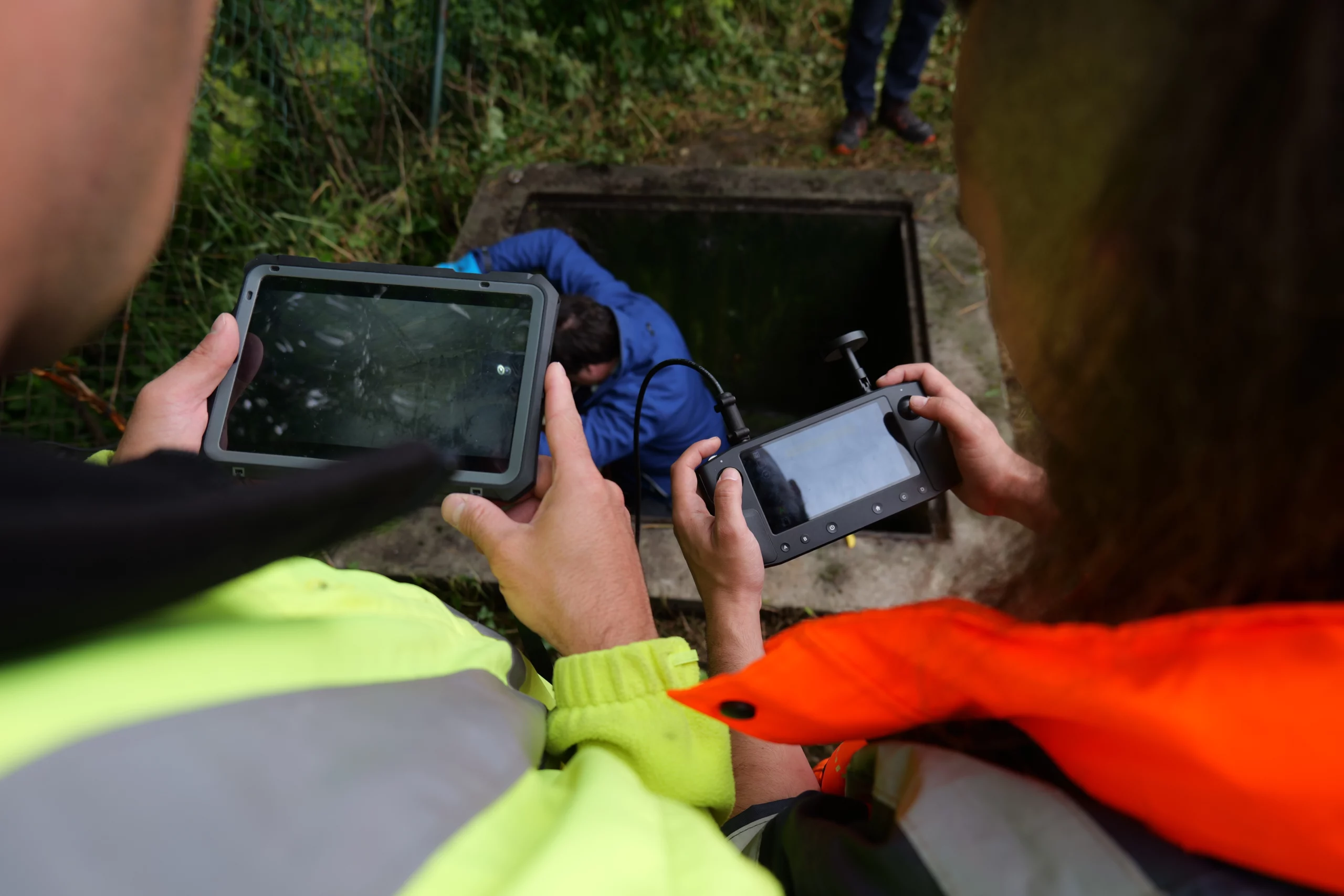
- Wireless connection: Unlike wired carts, the Roview2 operates without cables. It transmits images and data in real time via radio, freeing the robot from the constraints of cable length and reducing logistics.
- High-resolution camera + powerful lighting: Equipped with a turret-mounted 4K camera, it offers a panoramic view (360° horizontal, 180° vertical) and its high-power LEDs (up to 10,000 lumens depending on version) guarantee excellent visibility in dark environments.
- Autonomy and robustness: the Roview2 can operate for several hours depending on the mode (for example ~2 h in motion with LEDs, according to Multinnov), enabling long, in-depth inspections.
- Buoyancy: A key feature is that the Roview2 is amphibious: it can float and navigate in flooded sections of pipelines, technical rivers or partially-filled reservoirs.
- Safety and stability: the robot is designed to remain stable even on slopes (up to ~45°) and features a tip-over warning system at ~30°, ensuring safe operations.
- Telemetric measurements: It collects not only images, but also data such as distance traveled, orientation, inclination... enabling highly accurate diagnosis.
Thanks to these features, robots like the Roview2 reduce drudgery, risk and intervention time, while improving diagnostic quality.
Towards more intelligent, connected inspection
Robotic inspections are rapidly evolving towards intelligent, connected systems, opening up new perspectives:
- On-board intelligence: Robots can integrate image analysis algorithms to automatically detect anomalies (cracks, deformation, infiltration). Recent academic research is exploring deep learning-based anomaly detection methods to automate this step.
- Real-time transmission: The radio connection enables the operator to view live images, control the robot and make immediate decisions on inspection execution.
- Asset analysis: the data collected (images + telemetry) can be integrated into GIS (Geographic Information System) systems or asset management software, to plan work, prioritize sections to be rehabilitated and monitor network evolution.
- Predictive maintenance: By coupling regular inspections with AI analysis, operators can anticipate failures, reduce emergency interventions and save on infrastructure lifespan.
- Interoperability: Modern ITV robots are designed to be compatible with inspection standards, coded reports and usable formats, making them easy to integrate into management and maintenance processes.
TV inspection robots are revolutionizing the way professionals inspect wastewater networks, whether industrial or technical. By replacing time-consuming, risky and costly manual inspections with automated, safe and precise missions, they simplify heavy operations, improve safety and optimize diagnostics.
The Roview2 from Multinnov embodies this transformation: wireless, amphibious, autonomous, with a 4K camera and powerful lighting, it pushes back the limits of inspectability, even in the most complex environments. Thanks to technological developments (AI, telemetry, connectivity), inspection is becoming not only more efficient, but also more intelligent.
For local authorities, manufacturers or network operators, investing in ITV robots means investing in foresight, safety and sustainability: strategic issues in the age of critical infrastructures.