
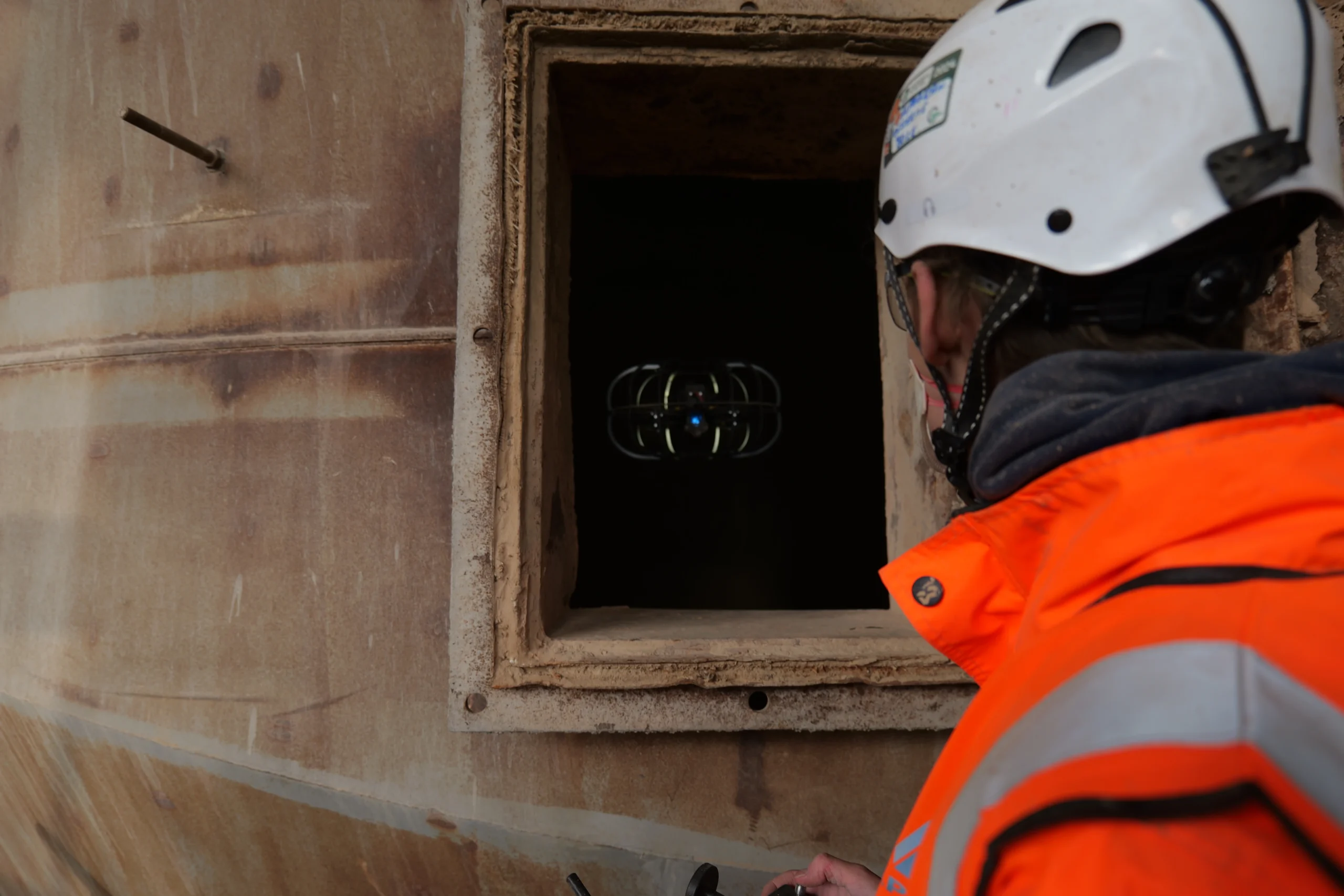
Televisual inspection (TVI) has been a mainstay of industrial and urban maintenance for several decades. Used to examine pipelines, underground networks, engineering structures and steel structures, it can identify defects, obstructions or structural risks before they become critical. Historically carried out with wire-guided forklifts equipped with cameras, this method is now showing its limitations in the face of field constraints and growing demands for performance and safety.
It's against this backdrop that inspection drones are emerging as a breakthrough technological solution. They offer unrivalled mobility, speed, safety and data quality. By enabling inspections in confined or difficult-to-access environments, they are redefining industry standards.
The limitations of conventional TV inspection methods
ITV forklifts are still widely used to inspect sewer networks, buried pipes and service shafts. But their operation is based on a rigid and restrictive system, which presupposes ideal conditions that are rarely found in the field.
Very limited mobility
ITV forklifts must travel on dry, smooth ground, free of obstacles and uneven surfaces. A pipe partially filled with water, a tight bend or a root can completely block their progress. They cannot climb, fly or overcome major physical obstacles. In some cases, inspections are cancelled due to lack of accessibility.
Heavy logistics
Deploying an ITV cart requires :
- a team on site to introduce the robot,
- wide access to the ends of the section to be inspected,
- a control cable in good condition (often fragile or limited in length),
- an intervention vehicle with control unit.
All this generates costs, time and risks. In the event of a maneuvering error or cable breakage, the cart can get stuck and require a recovery operation.
Limited image quality and angles
ITV carts offer mainly frontal vision, or a pivot-mounted camera that can be oriented, but framing possibilities are limited by the position of the cart. Visibility also depends on the quality of on-board lighting, which is often inadequate in large cavities.
What drones bring to inspection
Indoor or confined drones are not flying gadgets: they are engineering tools specifically designed to move around without GPS, in cramped environments, without light, sometimes without ventilation. They operate in extreme conditions where conventional solutions fail.
Unprecedented mobility
Unlike ITV carts, drones can :
- fly in all directions,
- adapt to complex volumes (tunnels, tanks, silos),
- over obstacles, debris and metal structures,
- remain stationary to capture still or panoramic images.
Their agility enables them to inspect non-rectilinear areas, without the need for entry points on either side.
Operational time savings
The drone can be deployed in minutes by a single operator. There's no need for a cable, intervention vehicle or dual access. Inspections are often carried out in a single, rapid operation, with complete and precise coverage.
Enhanced safety
Drones save inspection operatives from having to descend into narrow, dark, contaminated or dangerous networks. They enable diagnostics to be carried out without exposing humans to falls, noxious gases, rockfall hazards or electrical accidents.
High-definition images
Drones like the Stereo2 (Multinnov) or theElios 3 (Flyability) are equipped with 4K cameras, LED lighting up to 10,000 lumens and, in some cases, thermal or LiDAR sensors. This enables them to produce precise surveys that can be used by design offices or local authorities, with the option of 3D modeling or digital twins.
A revolution in industrial maintenance
Game-changing efficiency
Drone inspection reduces downtime, crew mobilization and diagnostic time. Some structures that used to take two days to inspect using the ITV method can now be checked in half a day.
Better infrastructure coverage
The drone can be used to inspect vertical structures (chimneys, silos), complex volumes or areas where space is at a premium. It fits in where the ITV cart is simply not an option. The aerial view also provides a new perspective on defects (cracks, infiltrations, welds).
Lower operating costs
By reducing the need for cumbersome logistics and speeding up inspection campaigns, the drone lowers the overall cost of a mission. What's more, its versatility means that a single team can cover several sites in a single day.
Complete data traceability
Each inspection is recorded, time-stamped, geo-referenced and archived. This makes it possible to compare deterioration over time, anticipate repairs and justify maintenance decisions to managers and insurers.
The case of Multinnov's Stereo2: a cutting-edge French solution
Among the market players, Multinnov stands out with its Stereo2 drone, entirely designed and assembled in France. This drone has been designed to meet the constraints of European industrial sites, where compactness, ease of use and reliability are key.
Stereo2 benefits
- GPS-free flight in confined spaces
- On-board 4K wide-angle camera
- LED lighting up to 10,000 lumens
- Stereovision navigation (collision-free)
- Assisted stabilization for hovering flights
- Ease of operation for technical staff
Stereo2 can fly in technical ducts up to 40 cm in diameter, in sloping networks, and in dusty, damp or dark environments.
A complete ecosystem
Multinnov also offers :
- training for indoor missions,
- drone sales,
- technical support based in France,
- customizable accessories (shells, protective covers, sensor interfaces).
Conventional TV inspection methods have long been the norm in underground networks and industrial environments. But in today's increasingly complex environments, heightened safety standards and budgetary optimization, these tools are showing their limits.
Indoor drones like the Stereo2, designed for visual inspections in confined environments, are changing the game. They deliver speed, precision, safety and cost savings. Their ability to navigate in areas inaccessible to ITV forklifts makes them a must-have technology.
The future of TV inspection lies ininnovation, agility and digitization - areas where drones are already at work.