
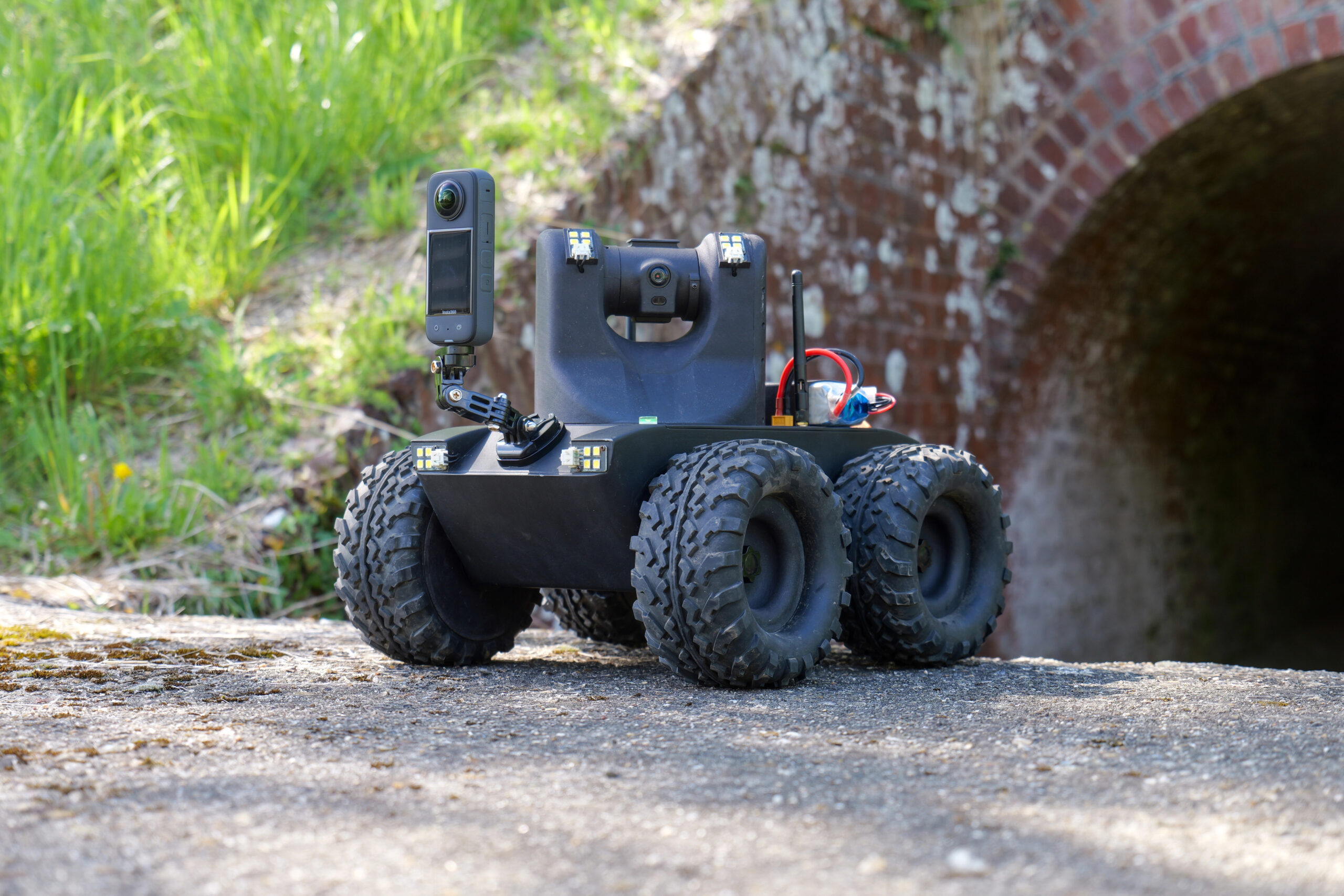
The maintenance of underground networks, whether sewer pipes or industrial infrastructure, is undergoing a revolution thanks to inspection robots. Where manual inspection or cable-guided carts struggled to overcome access constraints, new generations of robots, such as the Roview2 from Multinnov, offer a major technological advance. These machines combine increased mobility, high-definition vision, and intelligent diagnostic tools, enabling safer, faster, more accurate, and economically optimized inspection.
Major developments in robotics for pipe inspection
For a long time, the inspection of buried pipes relied on wire-guided carts or push cameras, which were limited by their range, maneuverability, and dependence on a cable. The emergence of wireless robots has profoundly reshaped this approach.
The Roview2, designed by Multinnov, is emblematic of this transformation. It is an ultra-light motorized robot capable of entering pipes of various diameters, even those that are partially flooded. Its maneuverability allows it to overcome obstacles, climb slopes, and adapt its trajectory to the environment. Thanks to its robust design, it can operate in confined spaces with humidity or water, which was once a major challenge for traditional systems.
This mobility, combined with autonomy, makes the robot particularly well suited to complex inspections where installing wired equipment is difficult or even impossible.
Technological innovations that improve diagnosis
Technological advances incorporated into robots such as the Roview2 enable significant improvements in the diagnosis of underground networks:
High-resolution vision and stabilization
The Roview2 is equipped with a 4K camera mounted on a turret that allows horizontal and vertical rotation. This provides complete visual coverage of the internal walls of the ducts, enabling micro-cracks, faulty joints, or areas of wear to be detected with impressive accuracy.
Powerful lighting
High-performance LEDs ensure optimal illumination even in completely dark ducts. This lighting, combined with the camera's resolution, guarantees clear images, which are essential for a proper diagnosis.
Wireless navigation
One of the Roview2's greatest strengths is its freedom of movement: thanks to its wireless transmission, the robot is free from the logistical constraints of cables and the risk of entanglement. It can explore long sections of networks without being limited by cable length.
Telemetry and location tracking
The robot collects telemetry data (distance traveled, orientation, inclination) which is recorded simultaneously with the video images. This information makes it possible to precisely locate the detected defects, facilitating their subsequent repair.
Predictive analytics
With visual and telemetric data, operators can implement predictive analysis techniques: detected anomalies are compared with databases to assess their progression over time. This makes it possible to anticipate failures before they become critical and optimize maintenance campaigns.
Benefits for underground network operations
The integration of such robots into maintenance strategies offers numerous advantages:
Increased safety for personnel
By entrusting inspection to robots, operators are less exposed to challenging or hazardous environments, such as narrow, damp, or partially submerged conduits. This reduces the risk of accidents and improves overall safety.
Reduction in major procedures
Wireless robots such as the Roview2 facilitate the inspection of network sections that would otherwise require excavation work, scaffolding, or sending personnel into hazardous conditions. The result: fewer service interruptions and lighter interventions.
Time saving
Thanks to their mobility and ability to record high-quality images, robots can quickly cover long distances. Live video feeds help to immediately identify problem areas, speeding up decision-making.
Economic efficiency
Less cumbersome logistics, fewer personnel required, more accurate diagnostics: all these factors contribute to reducing the overall cost of inspection operations. Ultimately, this can represent significant savings for network operators.
Optimized maintenance
Early detection and precise localization of faults enable a predictive maintenance strategy to be adopted. Repairs are planned more judiciously, which extends the service life of installations and limits costly emergency interventions.
Pipe inspection robots, represented by systems such as the Roview2 from Multinnov, represent a true operational revolution. By combining wireless mobility, high-definition vision, advanced telemetry, and predictive capabilities, they enable underground networks to be analyzed more safely, quickly, accurately, and economically than ever before.
For sewer network operators and maintenance professionals, investing in this technology means fewer interruptions, fewer risks for teams, and better control of assets. Thanks to these innovations, visual inspection of pipes is entering a new era: one of intelligent, sustainable, and cost-effective diagnostics.
Given the sustainability and efficiency challenges inherent in current network operating strategies, adopting robots such as the Roview2 is no longer a luxury: it is becoming a strategic necessity.