
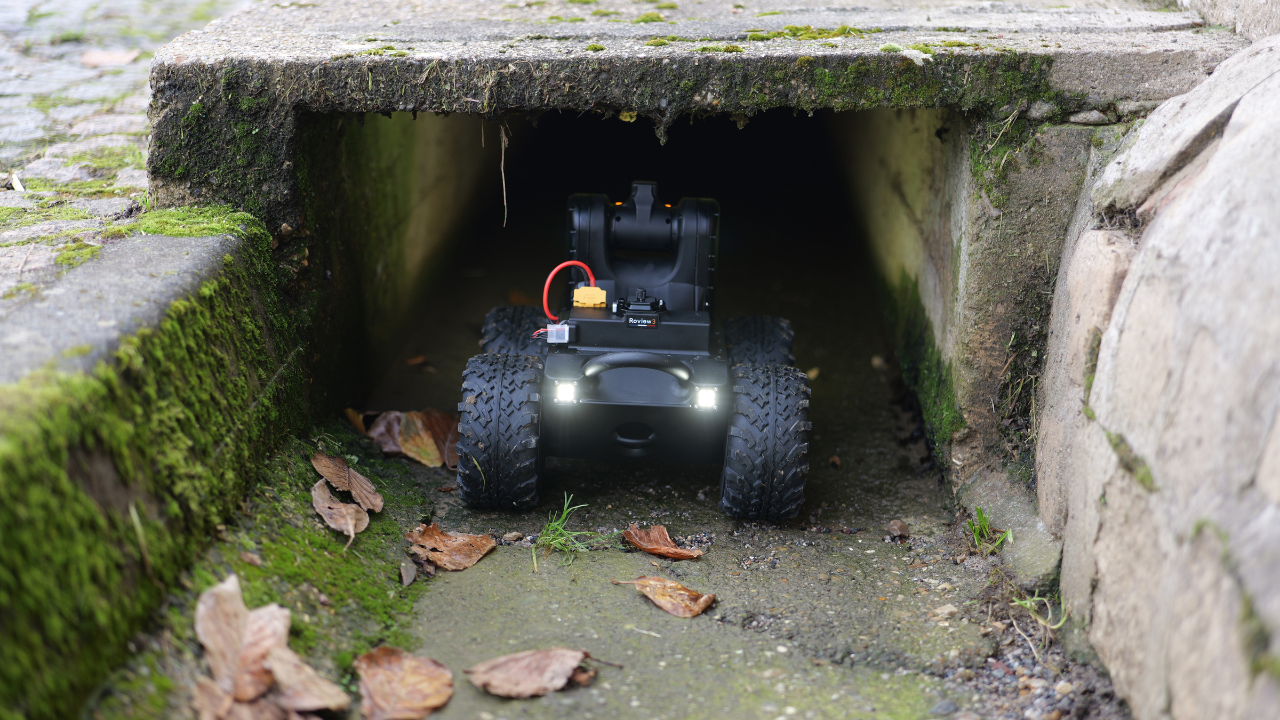
Television inspection of pipes is now an essential tool in the plumbing, sanitation, and network maintenance industries. It allows the condition of pipes to be diagnosed, anomalies to be located, and maintenance decisions to be made without resorting to invasive work.
Given the diversity of networks and field constraints, the choice of inspection equipment is crucial. Between traditional ITV trolleys and new-generation inspection robots such as the Roview 3, professionals now have several approaches at their disposal, each meeting specific needs.
The challenges of choosing a television inspection system
Choosing a television inspection system is not just a question of technology. Above all, it is a matter of adapting the tool to the realities on the ground. The networks to be inspected can vary greatly in terms of diameter, length, configuration, and accessibility.
Professionals must also deal with safety requirements, particularly in confined, damp, or degraded environments. Added to this are economic constraints: intervention time, staff mobilization, operating costs, and inspection frequency.
Unsuitable equipment can lead to incomplete inspections, wasted time, and even the need for multiple visits. Conversely, a system that is consistent with usage patterns improves diagnostic quality, team productivity, and operational profitability.
Two different approaches: Roview 3 and ITV trolley
The ITV cart: a proven and standardized solution
The ITV trolley has long been the benchmark for television inspection of pipes. Usually wired, mounted on wheels, and equipped with a swivel camera, it is designed to travel relatively regular networks over long distances.
This solution is particularly suited to standard inspections, especially in pipes with a constant diameter that are easily accessible. The ITV trolley offers good image stability and continuous data transmission, making it a reliable tool for one-off or scheduled inspection campaigns.
However, its wired nature and bulkiness can become limitations in complex, congested networks or those with significant access constraints. Implementation may also require more time and logistics.
Roview 3: a more agile and flexible approach
The Roview 3, developed by Multinnov, is part of a new generation of visual inspection robots. Designed to operate in challenging environments, it focuses on compactness, mobility, and rapid deployment.
More agile than a traditional ITV cart, the Roview 3 makes it easier to work in hard-to-reach networks, confined spaces, or non-standard configurations. Its design facilitates quick inspections without extensive preparation, which is a major advantage for professionals who frequently work on a variety of sites.
This flexibility makes it a particularly valuable tool for targeted diagnostics, preventive inspections, or interventions requiring a high degree of responsiveness.
Which solution should you choose based on your usage and constraints?
There is no universal solution. The choice between a Roview 3 and an ITV trolley depends primarily on the usage profile.
For flexible, frequent inspections carried out in challenging networks, the Roview 3 is often the most suitable solution. Its ease of use, agility, and ability to navigate complex environments save time while limiting operational constraints.
Conversely, for standard inspections over long distances, carried out on a more ad hoc basis, an ITV trolley can remain an effective and economically viable option. It perfectly meets the needs of regular networks where stability and continuity of inspection are priorities.
Many professionals choose to combine both approaches in order to have a range of equipment capable of responding to all situations encountered in the field.
Compare the Roview 3 and the ITV trolley primarily involves analyzing your actual inspection needs. While the ITV trolley is a proven solution for standardized inspections, the Roview 3 stands out for its flexibility, speed, and ability to adapt to challenging environments.
In a context where television inspections are playing an increasingly important role in network management, choosing the right equipment is essential for improving safety, efficiency, and diagnostic quality. A approach guided by real-world applications remains the key to taking full advantage of these technologies.