
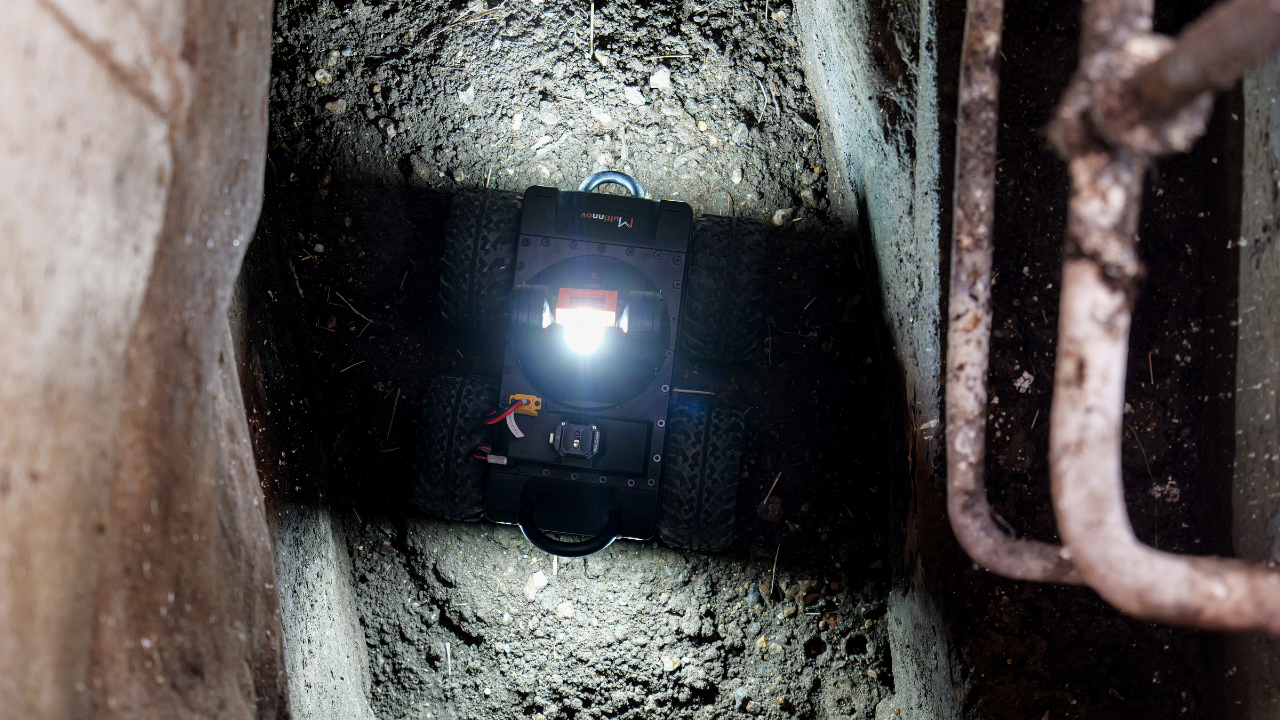
Rail infrastructure requires constant monitoring. Tunnels, underground structures, utility lines, tunnels, and related networks must be inspected regularly to ensure their reliability, safety, and availability.
In this context, Multinnov gave a demonstration of its Roview3 to the teams at SNCF Réseau. This meeting provided an opportunity to showcase the inspection robot’s capabilities in complex environments where human access can be difficult, restrictive, or risky.
The goal was clear: to demonstrate how a robotic solution can help field teams improve efficiency, ensure more reliable diagnostics, and reduce operator exposure in confined spaces.
Background and Challenges of the Intervention
SNCF Réseau is responsible for monitoring, maintaining, upgrading, and modernizing the national rail network. Its teams work across a wide range of areas, including tracks, overhead lines, electrical equipment, engineering structures, earthworks, tunnels, and signaling systems. Routine maintenance includes continuous monitoring of the network, as well as preventive and corrective measures designed to ensure the infrastructure remains robust.
Railway structures often present unique challenges. Tunnels, bridges, hydraulic structures, and utility tunnels often have limited access points, require scheduled maintenance, and involve strict safety requirements.
In this type of environment, inspections must address several priorities:
- quickly assess the condition of the structures;
- detect any anomalies;
- document findings accurately;
- reduce risks to operators;
- minimize the impact on operations.
Safety is a key priority for SNCF Réseau, which places operational safety, technical safety, and occupational health at the heart of its activities. The company also notes that bridges, tunnels, earthworks, and other network components are subject to regular inspections.
It is precisely these issues that inspection robot solutions such as the Roview3 can add value.
The Roview3: an innovative technological solution
The Roview3 is a TV inspection robot developed by Multinnov. It was designed to perform visual inspections in demanding environments, including sewer systems, pipelines, and hard-to-reach areas.
Its design is based on several technical advantages confirmed by Multinnov :
- wireless control;
- 4K30i camera;
- 16,000-lumen lighting;
- battery life of more than two hours;
- completely watertight;
- buoyancy;
- Video footage and photo/video recordings to document the inspection.
These features are of direct interest during demonstrations for railway crews. Wireless control simplifies on-site logistics, while the high-definition camera provides images that can be used for analysis.
Powerful lighting is also an important factor. In underground or enclosed facilities, visibility is often limited. High-quality lighting therefore directly affects the reliability ofvisual inspections.
The Roview3 thus makes it possible to explore areas without immediately sending an operator into the environment to be monitored. The robot acts as a field relay: it observes, records, and transmits the information needed for decision-making.
This approach is part of the evolving landscape ofvehicle inspection and technical diagnostics. It does not replace human expertise, but rather enhances it with precise visual data collected under safer conditions.
Results and Outlook for Rail Infrastructure
The demonstration of the Roview3 to SNCF Réseau illustrates the growing interest among industry players in robotic inspection solutions. In the rail sector, there are numerous needs: monitoring of underground structures, tunnel inspections, inspection of wet areas, and analysis of hard-to-reach infrastructure.
The potential benefits are tangible.
Greater safety for teams
By sending an inspection robot on a preliminary reconnaissance mission, operators can limit their direct exposure to hazardous areas. This allows for better preparation of human interventions when they are still necessary.
This approach aligns with SNCF Réseau’s safety priorities, as the company mobilizes its teams and partners to follow strict procedures for construction projects and maintenance. In 2024, SNCF Réseau reports having carried out 1,600 construction projects across the network, with a strong emphasis on safety culture.
Faster diagnoses
The Roview3 can help reduce the time required for certain phases of visual reconnaissance. Rather than immediately deploying heavy equipment, teams can quickly obtain an initial set of actionable intelligence.
This speed helps improve the organization of maintenance operations.
Improved traceability
The images, videos, and data collected help document findings. This traceability is essential for tracking changes in a structure over time, prioritizing maintenance work, and sharing information among teams.
SNCF Réseau is already emphasizing the importance of data collection and monitoring in order to gradually transition from corrective maintenance to predictive maintenance.
More targeted maintenance
Through careful visual inspection, teams can better identify issues and tailor their response. This prevents unnecessary work, reduces costs, and improves overall efficiency.
For Multinnov, this demonstration confirms the effectiveness of the Roview3 in demanding industrial environments, beyond just sewer systems.
The demonstration of the Roview3 to SNCF Réseau highlights a major shift in inspection practices: using robotics to more easily access complex environments, collect reliable data, and enhance team safety.
With the Roview3, Multinnov offers a solution tailored to the challenges of confined spaces and hard-to-reach infrastructure. Its wireless control, high-definition inspection camera, powerful lighting, and ability to document operations make it an ideal tool for modernizing field inspections.
In the railway sector, where safety, infrastructure availability, and diagnostic accuracy are essential, inspection robots offer real opportunities for faster, more precise, and better-managed maintenance.